
Stop paying Claude every month. Compile the work.
Uber burned its 2026 AI coding budget by April. The smart move is not to audit the bill. It is to never run it again.
The signal (TL;DR): AI is no longer cheap. Uber burned its 2026 Claude Code budget by April.
Walmart killed unlimited tokens. Bain says 44% of companies are funding next year’s AI spend on savings that have not shown up.
This week’s play: walk into one mid-sized agency, replace ONE recurring AI workflow with deterministic code, and take 25% of the savings. The free kit to run it is below.
In early June, the AI bill stopped being a rounding error. Uber capped every employee at $1,500 a month after the company burned its 2026 Claude Code budget by April. Walmart shut down unlimited tokens on its internal Code Puppy agent. Sam Altman went on CNBC and said the quiet part out loud:
“I am spending a ton of money on AI, and I know there is a ton of waste.”
Bain ran the numbers in April: 40% of large companies reported AI cost savings under 10% against a target of 11 to 20%. 44% of all respondents said they were planning to fund the next wave of AI investment from those targeted savings. Many of those savings have not arrived.
Every newsletter that covered June’s reckoning told you the same thing: do an AI spend audit, switch to cheaper models, use OpenRouter. That is the consensus play. It lowers the rate. It does not change the shape of the invoice.
The smarter move shows up in Markie Wagner’s “Return on Tokens” essay on Not Boring, published in early June. Stop renting reasoning by the token. Compile the work.
Free kit below. Let’s get into it.
THIS WEEK’S BIG THEME: COMPILE THE WORKFLOW
Start with one line, from Markie Wagner’s “Return on Tokens” essay in Not Boring.
“AI is a compiler, not a runtime. Thinking is expensive but rare. Doing is cheap and forever.”
Read it twice. That single sentence reframes the entire bill.
A compiler runs once. It looks at a problem, learns the rules, and writes the code. The code runs forever, cheaply, deterministically. A runtime runs every time you use it. Every token, every second, every retry, on the meter.
For the last two years, every operator who picked up Claude or ChatGPT made the same mistake. They put the runtime in production.
They let the agent loop on every customer report, every weekly summary, every lead score, every proposal draft. The bill scaled with usage.
The output still needed a human review.
In June, the bill caught up.
The receipts. Uber: 2026 Claude Code budget gone by April, $1,500-per-month per-employee cap on agentic coding tools (Bloomberg, TechCrunch, June 2). Walmart: unlimited tokens dead on internal Code Puppy (Bloomberg, June 1).
An anonymous enterprise client, per Axios reporting (late May): $500 million on Claude in a single month after failing to set per-employee usage caps.
NLW has said on the AI Daily Brief that the team’s own Context Portfolio Builder cost roughly $5,000 across six weeks.
Amazon scrapped its internal KiroRank leaderboard after staff started gaming it with costly busywork (The Decoder, June).
Ramp’s Veeral Patel, via Markie Wagner’s piece, coined “Token Casino.” Palantir’s Alex Karp, at AIPCon 10, called it “kind of like a porn addiction.”
The buried answer. While CFOs panicked, one small company quietly showed the way out.
Poetic, run by Markie Wagner, is deployed at AIG, SoFi, and Chime. AIG CEO Peter Zaffino, on the record: “Poetic has already achieved 99%+ quality outcomes on multi-hour processes.” How?
They send their engineers, many of them ex-Palantir, on-site in Nebraska, Providence, wherever the work happens. The engineers sit on someone’s shoulder for a week and ask, hundreds of times, what did you just do, and why.
They turn the answers into rules. They turn the rules into code.
Pay for the thinking once. Run the doing forever.
The result: 100 times less token usage, at 99% accuracy. The work that used to be done by an agent looping on $2 per run is done by a script that runs for cents.
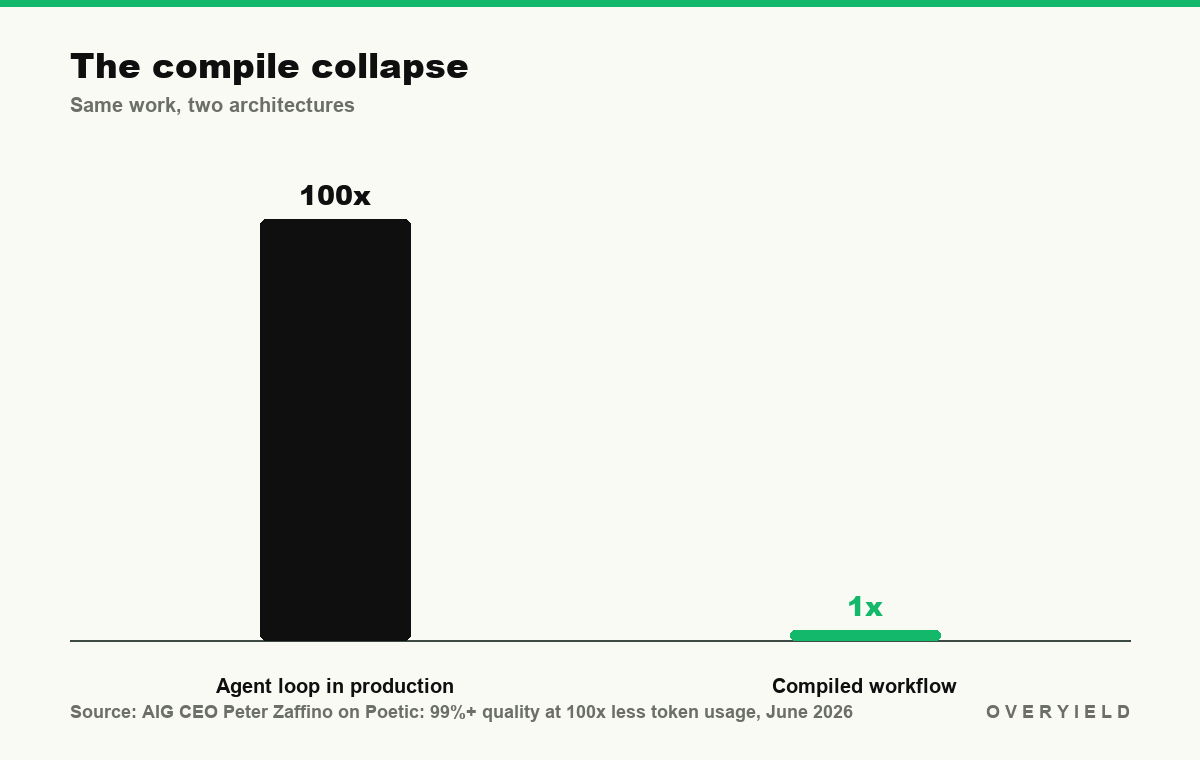 The compile collapse
Same output. One hundredth the bill.
Stop renting reasoning. Compile the work.
That is the play. The consensus says cap the bill. The variant says replace it. Compile one workflow into a deterministic script, charge from the savings, and own the relationship.
Who loses. NLW has been hammering the same point on the AI Daily Brief: every AI business is now a token-efficiency business.
The losers are the agencies and SaaS shops still selling “AI transformation” as a flat retainer with no proof of cost reduction. They are about to get phone calls from CFOs who can read a bill.
Who wins. The operator who picks one recurring workflow at one mid-sized company, sits next to the human who runs it, encodes the tacit rules into code, and charges from the measured savings. That operator has a renewable cost-out wedge, not a chatbot.
You do not need to be Poetic. You need to find one weekly report, one proposal draft, one lead screen at one agency, and compile it.
THE PLAY: THE COMPILE CUT
Effort: medium-high · Cost to start: under $100 · Time to first $: 7–14 days · Skill: spreadsheet logic, basic scripting (n8n, Make, Apps Script, or Python with Cursor), process interviewing, simple QA
Buyer. A 25 to 150 person AI-heavy agency or B2B ops team with a recurring AI bill. Start with paid media agencies, SEO and content shops, recruiting firms, RevOps teams, and customer-success teams.
They run the same kind of AI task every week and they already have a usage log or a Claude or OpenAI invoice they can show you.
Pain. AI is helping, but the bill scales with every run. The output still needs review. Their finance lead cannot tell whether more tokens mean more shipped work or more retries on the same job.
Offer. One workflow, compiled once. You replace a long live prompt with a small script and a sheet.
You run it side-by-side with their old agent for two weeks, show the same outputs at a fraction of the cost, and bill from the measured savings. You are not selling automation.
You are selling a smaller invoice with the same work shipped.
Who pays whom. They pay you. Not the other way around.
- $500 diagnostic deposit up front to map the workflow, pull 30 days of usage, and build the baseline.
- $750 build fee when the client accepts the compiled version for the two-week side-by-side test.
- 25% of verified monthly AI savings for 3 months, capped at $1,000 total success fee.
The proof. Before you start, screenshot the 30-day baseline: runs per month, cost per run, total spend. After 30 days on the compiled version, screenshot the same fields. The delta IS the testimonial. Round down. Believable beats impressive.
A worked example. A 45-person paid media agency runs 500 weekly client report drafts a month. The current process: one long Claude prompt eats the CSV exports from Meta Ads and Google Ads, then writes the full report. Cost per run: about $2, all-in. Monthly bill: about $1,000.
You compile it. The CSV exports drop into a Google Sheet.
Apps Script calculates spend pacing, CPA movement, ROAS movement, conversion volume, anomalies, and account flags. A template fills in the report from rules.
A single small model call writes the two-sentence executive summary, but only when an account has a flagged change. New cost per run: closer to 50 cents.
New monthly bill: about $250.
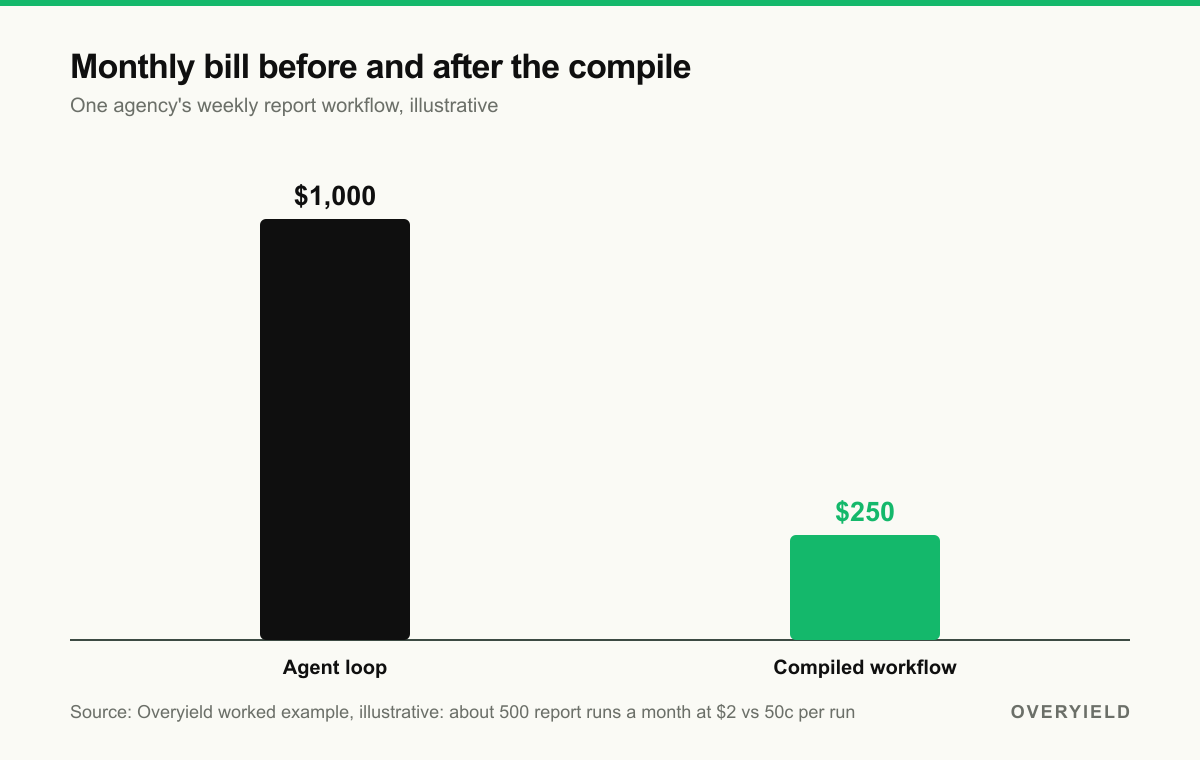 Monthly bill before and after the compile
Verified savings: $750 a month. You get $500 plus $750 plus 25% of $750 for three months. Round down: about $1,800 in your pocket from one workflow at one client. Do it again. And again.
First move (48 hours). Pick one vertical. Paid media agencies are the cleanest start because the input (ad-platform CSVs) and the output (a weekly report) are both standardized.
Build a fake demo first. Use one of your own ad accounts, or a public sample dataset. Show two screens. Before: one long prompt writing the full report at $2 per run. After: a sheet that calculates everything, fills the template, and runs the model only for the summary, at 50 cents per run.
Then send 20 plain notes. Cold or warm. Owners, ops leads, finance leads.
*"I am looking for one recurring AI workflow that runs 50 or more times per month. I will map the current cost, compile the repeatable parts into a cheaper workflow, and bill from the measured savings.
Good fits are weekly reports, proposal drafts, content refreshes, lead screens, and client summaries. Bad fits are one-off strategy and creative brainstorming.
Can I look at one workflow this week?"*
The honest part. This does not work for fuzzy strategy, high-stakes final calls, or one-off research. It fails if the buyer will not share usage logs or sample outputs.
The first build takes 10 to 15 hours of real work. If the target workflow costs less than $300 a month today, walk away.
The math will not be clean enough to defend.
This is not “be the Poetic of insurance.” That is a venture-backed enterprise company. This is the beginner cut: one repeating task with one bill, at one company that can decide on a Friday.
THE TOOL (FREE)
The Compile Cut Kit. The mini-product I wish someone had handed me: one workflow, compiled end to end (grab it free). Inside:
- the diagnostic SOP
- the 45-minute operator-interview script that pulls the tacit rules
- the rules-document template
- the build playbook, with examples for Sheets + Apps Script and n8n
- the 20-case eval table and the two-week side-by-side test protocol
- the savings receipt that becomes your invoice
Including a worked paid-media example you can clone and the exact outbound note above, with the seven workflow types I would pitch first.
Do it in 5 minutes. Pick one paid-media agency you already know on LinkedIn. Send the warm note above. While you wait for the reply, open the kit and run the demo on a sample Meta Ads CSV. You will have your before/after screen ready by tomorrow.
Want one play like this every Monday?
Free every week, with the done-for-you kit to run it.
WHAT THIS MEANS FOR YOU
If you already run an agency or a small SaaS. Look at your own AI bill first. Pick the one recurring workflow you run more than 50 times a month. Compile it for yourself this weekend. Your own before-and-after is your sales asset. Then sell the same compile to a peer.
If you are starting from zero. Pick paid media agencies, between 25 and 150 people, in one city. Build the demo once on a public dataset. Send the 20 notes. One yes is your first $1,800 client.
If you already do AI client work and feel the rate pressure. Reframe the offer. Stop selling “AI implementation.” Start selling “compiled AI workflows with a savings receipt.” Your retainer turns into a cost-out wedge. The math defends itself.
If you are an operator inside a company, not a freelancer. Run the kit on the one workflow your manager keeps complaining about. Save the company $9,000 a year on the meter. Send the screenshot to your CFO with one sentence: “I built this on a Saturday.” That is a promotion case, not an email.
THE CATCH
The biggest risk is not technical. It is fuzzy buyers.
If the client cannot show you 30 days of usage or 20 sample outputs, the savings math has nothing to anchor on, and you will end up arguing about a number neither of you can prove. Walk away from those.
Find the buyer who can open their billing dashboard on the first call.
The window is also real. Token prices are dropping.
Brian Armstrong said publicly in June that 80% of workloads will be on models 99% cheaper inside 12 to 18 months. That makes the deterministic-code shape MORE valuable, not less.
The buyer who compiles one workflow today and routes the leftover model calls to a cheap open-source model next quarter compounds the savings twice.
The buyer who keeps paying frontier prices for a runtime loop in 2027 is losing on both sides.
HERE’S THE BOTTOM LINE
The month’s receipts all point the same way: Uber capped, Walmart cut, and the one vendor with 99% quality on the record got there on 100x fewer tokens. This is the second beat of Overyield’s running arc.
The June 15 issue said: AI stopped being a seat and became metered labor, so prove the workflow paid. This one says: now compile it, so you stop paying for it every month.
Pick one workflow. Compile it. Bill from the savings.
New plays land Monday mornings. Subscribe free.
The locked library is already bigger than this week.
This week’s play is free. The rest of the Vault in Pro is not.
Each one is a complete play with the prompts, templates, scripts, and kit to run it. Review engine.
SOP forge. Sales-call goldmine.
Recruiting shortlist sprint. The Local-News PR Play.
The McKinsey Teardown. Sell to AI Agents.
A new one banks in every Monday. This kit stays free to keep and run.
The done-for-you version, the Compile Cut Operator’s Edition, lives in Pro with the rest of the Vault.
The deeper version of this play is the part I would not put on the public site.
Free gives you the play. Pro gives you the deeper, done-for-you build.
This week’s Pro upgrade: The Compile Cut Operator’s Edition. The seven highest-yield agency workflows (weekly performance report, monthly client review, proposal draft, content refresh brief, recruiting screen, customer-success summary, invoice classification), each delivered as a complete install: the filled rules document, the working script, the 20-case test set, and the savings dashboard your client wants to see.
These ship to members as a rolling build, flagship weekly report first, and founding members set the order of the rest.
Plus the closer scripts, the contract template, the share-of-savings tracking sheet, and the playbook for stepping up from one workflow to a company-wide compile.
And the forward-only track-record scorecard, where every call we make gets graded in public. No backfills.
Misses stay.
The founding price never changes.
Founding members lock $129 a year, forever. The founding rate closes when the first 25 members are in.
After that, the standard price rises toward $399 as the library and the scorecard grow, but every founding rate stays locked. This issue’s worked example alone, about $1,800 from one client, pays for the year fourteen times over.
Join founding: $129 a year, locked forever Checkout takes a minute. Your license key arrives by email and opens the Vault.
Out-yield the average. Javier @ Overyield
Know an agency owner whose AI bill keeps growing? Forward this. They will owe you one.
Overyield is educational, not financial, legal, or business advice.