
Prompts became debt. Sell the cleanup.
A new model ships every six days on average. The instructions wrapped around the old ones just pile up. The operator who owns the deletion bills quarterly.
The signal (TL;DR): In late July, OpenAI showed that fixing two settings in a benchmark harness tripled its model’s score, from 13.3% to 38.3%, with the model unchanged.
The same week, word spread that Anthropic had deleted more than 80% of Claude Code’s system prompt for its new models with no measurable loss on coding evals. Models now ship every six days on average.
The instructions stacked around them do not improve. They pile up, contradict each other, and quietly go stale.
This week’s play: The Instruction Diet, a small scanner product you sell to AI development agencies for $249 a quarter, finding the dead rules before they cost another developer day. The free Instruction Diet Kit is below.
The loud story of the week was money. Aschenbrenner’s Situational Awareness fund ran roughly $30B of equity, levered around 4x, got margin-called, and was absorbed by Citadel inside a day, per The AI Daily Brief on July 31.
The same day, Axios put Anthropic at a ~$71B revenue run rate and The Information had ChatGPT closing in on a billion weekly users.
Every newsletter you read this week will argue about what that means. Bubble or supercycle. Pick a side, change nothing about your Monday.
The quieter story has an invoice in it. Two results landed in late July that reprice a thing almost every AI-heavy team owns and none of them maintain: the pile of instructions their agents run on.
The model got smarter. The wrapper got heavier. Only one of those fixes itself.
Let’s get into it.
THIS WEEK’S BIG THEME: INSTRUCTION DEBT
Start with the benchmark nobody could explain.
On ARC-AGI-3, a reasoning benchmark, OpenAI’s Sol scored 13.3%. OpenAI’s engineers went looking and found the problem was not the model.
The official test harness was forgetting the model’s reasoning every turn and had compaction disabled. Fix those two settings and the same model scored 38.3%, on 6x fewer output tokens (Ben’s Bites, July 30).
ARC Prize agreed the result is real while defending its own no-harness testing, per The Innermost Loop on July 31.
Read that again. The model never changed. The instructions and plumbing around it were worth 25 points.
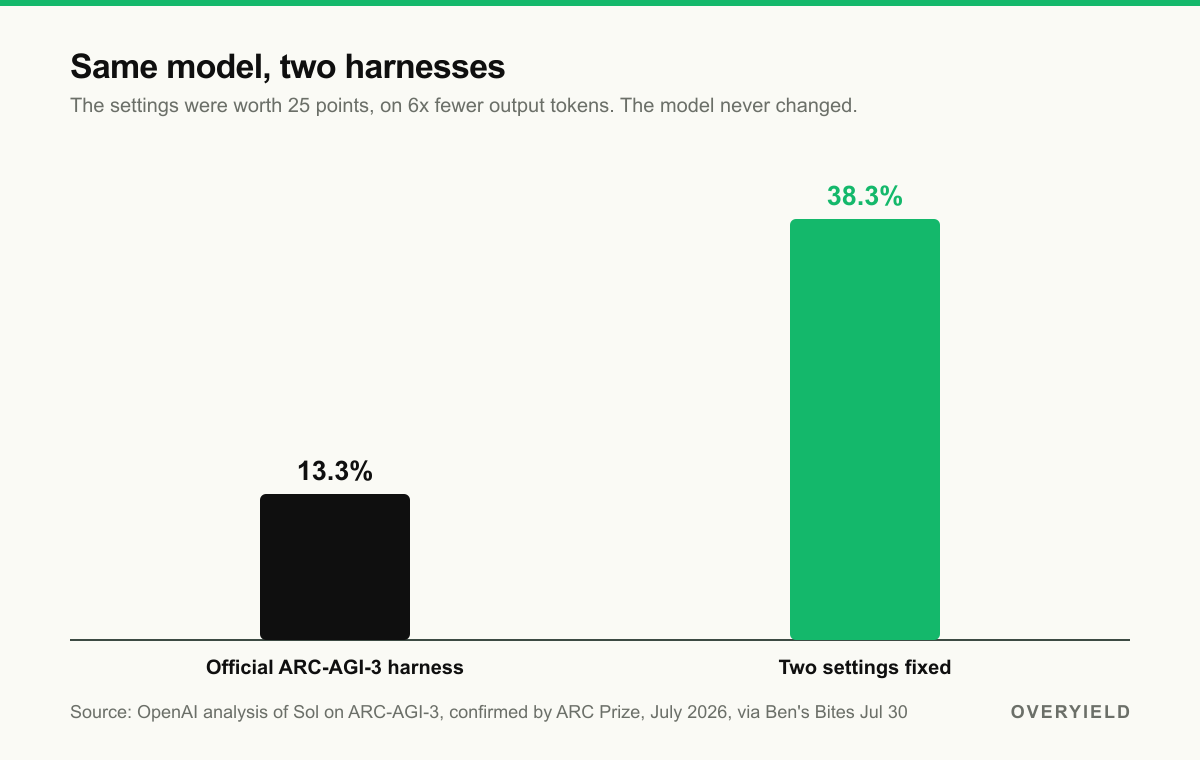 Same model, two harnesses: the settings were worth 25 points
Now the second result, from the other direction.
When Anthropic shipped Opus 5 in late July at half the price of its flagship, it disclosed something stranger: it had removed more than 80% of Claude Code’s system prompt for the new models, with no measurable loss on coding evals.
The biggest AI coding tool on the market ran for months on instructions that were mostly dead weight.
What the consensus took from this: learn context engineering. Trim your prompts. Scaffold smarter. All true, all advice, none of it a transaction.
What the consensus missed: instructions are not a one-time build. They are an asset that depreciates every time the model underneath them changes.
And the model underneath them now changes constantly: on Moonshots on July 29, Salim Ismail counted a frontier model release every six days on average over the past three months.
Every AI-heavy team has been writing rules, examples, and skill files for two years. Rules for models that no longer exist.
Examples that load on every task whether they apply or not. Two files that flatly contradict each other, written by two people who never met.
When the agent gets slow or erratic, nobody suspects the pile. They blame the model, and add more instructions to the pile.
There is a name for this in software: technical debt. It now exists in plain English, and it compounds the same way.
The upgrade is not what you add. It is what you finally get to delete.
Deletion has no owner. Writing new instructions feels like progress; removing old ones feels like risk, so nobody budgets for it. That gap between what depreciates and who maintains it is where this week’s money is.
THE PLAY: THE INSTRUCTION DIET
Effort: medium · Cost to start: $0-50 · Time to first $: 7-14 days · Skill: light scripting, careful rule design, outbound sales. Beginner-plus.
This is a build-a-product week: a small, boring, recurring product you can have working in a weekend.
Buyer. A 2-20 person AI development agency running coding agents across at least 10 client repositories, with instruction files everywhere: AGENTS.md, CLAUDE.md, Cursor rules, skill files. They exist in volume and in public: Clutch’s AI development directories list them with websites and contact paths.
Pain. The agency’s instruction pile grew across models, staff, and clients, and nobody owns the cleanup. Summarizing Every’s review of Opus 5, Ben’s Bites put the cost plainly on July 28: the model argues, stops early, and
“fights the skills people built for older models.”
The skills were an asset in March. By July they were drag. No one at the agency can say which of their thousand rules still earn their place.
Offer. Find the instruction debt before it costs another developer day.
Your product runs locally on the agency’s machine, inventories every instruction file, and flags the structural problems with exact line references: duplicates, contradictions, dead file paths, obsolete model names, oversized always-loaded examples.
Then it prepares a cleanup patch a human reviews. It never edits anything on its own.
Who pays whom. The agency pays you $249 per quarter, per workspace, which is roughly one developer-day of the rework it is meant to prevent. Your costs are about $9 in payment processing and $10 in delivery infrastructure per workspace. That is $230 net to you per sale, and it renews.
The math, modest case. Fifty researched contacts from Clutch take about five hours.
Land two paying workspaces, add 45 minutes of onboarding each, and you are at roughly 3.25 hours per sale: $230 divided by 3.25 is about $70 an hour.
The renewal is where it gets good: a quarterly update cycle takes maybe half an hour of support per workspace. Do not model more than two customers from the first fifty contacts.
The product either earns the renewal or it doesn’t.
The proof. Anthropic already ran this play on itself: 80% of the instructions deleted, zero measured loss.
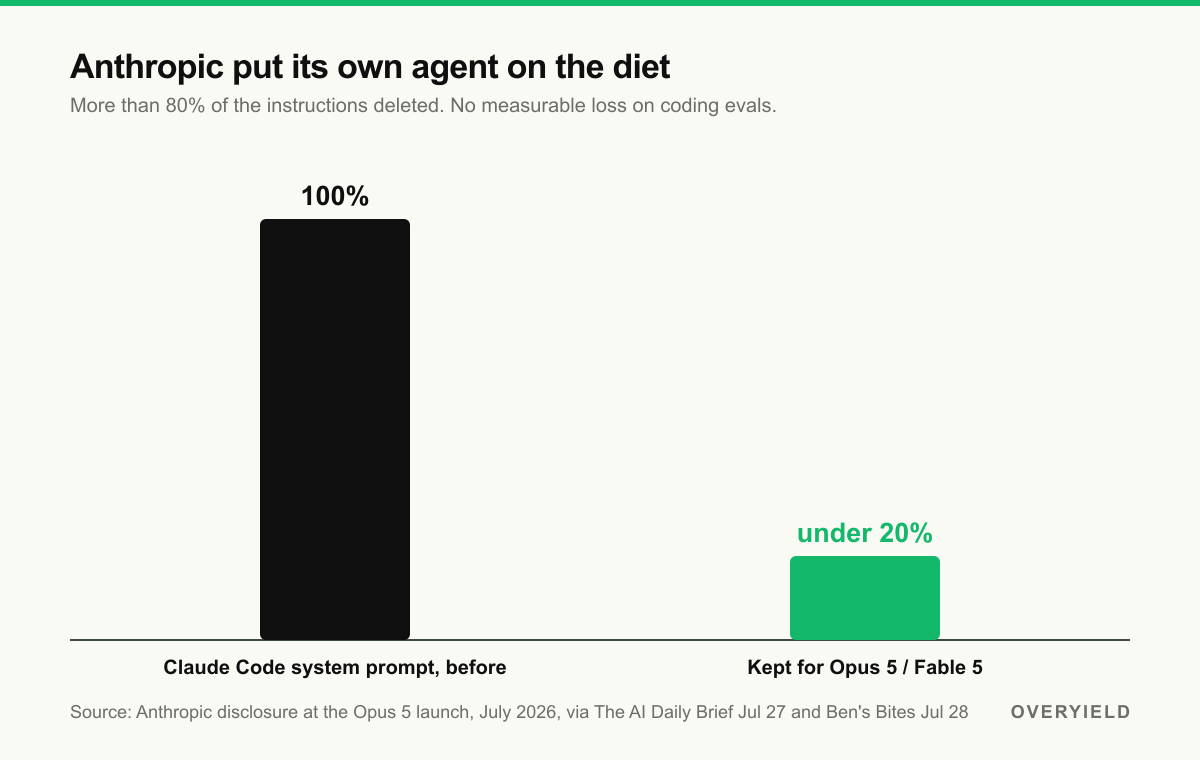 Anthropic put its own agent on the diet
A worked example. Northstar Dev, a hypothetical 14-repository agency, scans one client workspace.
The scanner finds the rule “explain the plan before editing” duplicated five times across three files; an AGENTS.md that says never create a database migration while a backend skill says always create one; a 1,900-token migration example loading on every task; seven rules naming Opus 4.8 on a repository that moved to Opus 5; two rules pointing at a style guide deleted months ago.
The proposed patch cuts always-loaded context from 11,600 tokens to 4,200. The product does not claim 64% smaller means 64% better.
It claims every change is traceable to a source line, and the agency’s own tests decide the merge.
Nobody owns the deletion. That is the job.
First move (48 hours). Day one: build the scanner with the free kit below (a coding agent writes the first version in an afternoon), run it on the kit’s fixture repository, and record a 90-second demo. Day two: pull 50 agencies from Clutch and send the first 20 one question: “Who removes agent instructions after a model upgrade, and how do you catch two rule files that contradict each other?” Offer two founding workspaces at $249 a quarter.
The honest part. A static scanner proves duplication, contradiction, and staleness. It cannot prove that deleting a rule makes the agent perform better; only the buyer’s own tests can.
That is why it flags and proposes, never auto-deletes. Agencies with one tidy instruction file have no reason to pay you.
The MVP is 12-16 focused hours before any sales time. If 50 qualified contacts produce fewer than five real replies and zero paid workspaces, kill it or reprice it.
Do not argue with the market.
THE TOOL (FREE)
The Instruction Diet Kit builds the scanner and the sales motion with you, fixture first (grab it free). Inside:
- the build prompt that has a coding agent write the v1 scanner in one session
- the 18 deterministic checks: duplicates, conflicts, dead paths, stale models, scope errors
- the fixture repository spec: a deliberately messy three-file demo workspace
- the instruction inventory: the nine columns that make debt visible
- the conflict matrix and review queue templates, with the five verdict labels
- the patch rules: propose, never apply; every change traced to a line
- the buyer qualification sheet and the 20-contact outreach note
- the pricing script: $249 founding, and when to say no
Do it in 5 minutes. Open the kit, copy the fixture repository, and run the build prompt against it. The mess it finds is your demo.
The scan is the demo. The deletion is the product.
Want one play like this every Monday?
Free every week, with the done-for-you kit to run it.
WHAT THIS MEANS FOR YOU
If you’re starting from zero. This is one of the rare product plays with no reputation requirement: the scan output is the credibility. One 90-second demo of the fixture repo does what a portfolio site cannot.
If you already do client work with AI. Run the scanner on your own instruction files first. You will find the same five ghosts Northstar found, and the cleanup makes your own delivery faster before you ever sell it.
If you run an agency or a team. You are the buyer. The engines keep getting cheaper: OpenAI cut GPT-5.6 Luna’s output price 80% to $1.20 per million tokens in late July, per The AI Daily Brief on July 31.
Every dollar you save on tokens can be quietly lost to a bloated, contradictory instruction layer no one audits.
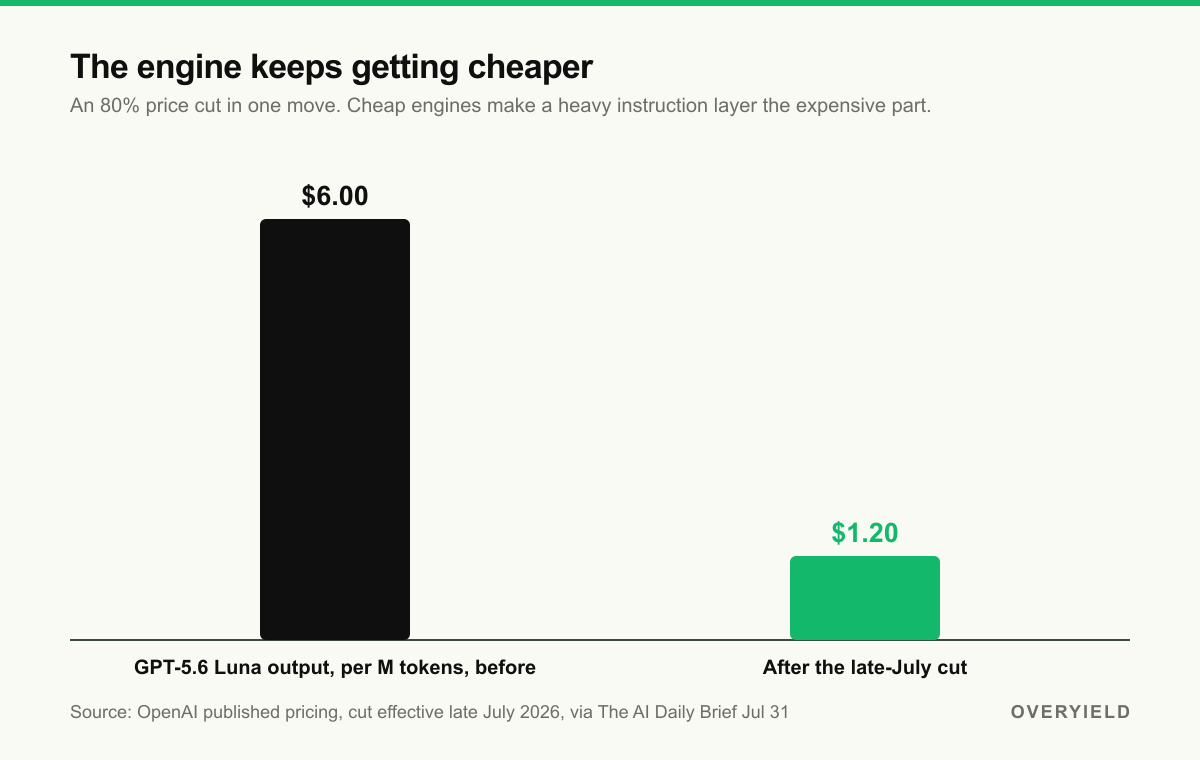 The engine keeps getting cheaper. The wrapper is where the drag lives.
If you sell prompts, skills, or “context packs.” Your inventory depreciates every six days now. Add a dated changelog and a staleness check to what you sell, or watch buyers discover the decay before you disclose it.
THE CATCH
The window has a clock on it. The scaffold problem is real today, but the labs are absorbing it: on the same Moonshots episode, Alex Wissner-Gross put the depreciation in one line:
“Today’s scaffold is tomorrow’s baseline capabilities.”
The most important thing to tell you is that this has already started.
On the same July 27 podcast that supplies the 80% deletion receipt above, Anthropic’s own Tariq encouraged everyone to do a skills cleanup with the new model release, and said Anthropic has shipped a doctor command to help do it automatically.
So the vendor whose disclosure created this opening is already shipping part of the cleanup itself. What it does not do is cross a dozen client repositories at once.
It does not hold a review queue. And it does not produce the quarterly evidence an agency hands a client to justify the invoice.
That gap is the product. Narrower than it looks, but real.
I put the odds of a major vendor shipping cross-repository staleness and conflict detection within 12 months at better than even, and that call goes on the scorecard.
The durable asset is not the script: it is being the person a dozen agencies trust inside their rule files by the time it does.
And the macro bear case is real. Dalio told Diary of a CEO on July 30 that Grantham is right to call this the biggest investment bubble in American history.
If AI budgets contract, agencies die faster than their instruction debt does. The product survives a downturn better than most AI services because it cuts waste rather than adding spend, but a dead client renews nothing.
Qualify for agencies with real client rosters, not runway-burning startups.
This is not for everyone. If reading someone else’s config files line by line sounds unbearable, skip this one. The product is care, applied quarterly.
HERE’S THE BOTTOM LINE
Late July drew the line twice: two harness settings were worth triple the score, and 80% of the market-leading coding agent’s instructions were dead weight all along.
Models now turn over every six days; the rules wrapped around them just pile up, and nobody owns the deletion. For a weekend of building and five hours of outreach, you can be the one who does, at $249 a quarter, renewing.
Scan the pile. Propose the patch. Bill quarterly.
New plays land Monday mornings. Subscribe free.
The locked library is bigger than this week.
This week’s play is free. The Pro Vault is not: 45 plays and counting, each a complete play with the prompts, templates, and checklists to run it, with a new one banking most weeks. The essay always stays free. The runnable kit retires into the Vault when the next issue ships.
The deeper version is the part I’d never post publicly.
Free gives you the play; Pro gives you the deeper build.
This issue’s is The Cleanroom: the ready-to-run scanner with all 18 checks implemented, the filled Northstar fixture workspace, the conflict-matrix and review-queue spreadsheets, the outreach-to-renewal pricing ladder, and the quarterly update SOP. It gets built out with the founding cohort, on top of the six finished builds already on the shelf: the Spread Desk, the Pack Line, the Operator’s Edition, the Rep Desk, the Call Pack Studio, and the Proof Room.
Plus the community that opens when the founding cohort is in, and the forward-only scorecard where misses stay on the board.
The founding price never changes.
Founding members lock $129 a year, forever. The founding rate closes when the first 25 members are in. After that, the standard price rises toward $399 as the library and the scorecard grow. The Vault opens the moment your license key lands.
Join founding: $129 a year, locked forever Checkout takes a minute. Your license key arrives by email and opens the Vault.
Out-yield the average. Javier @ Overyield
Know someone whose agents got weird after the last model upgrade? Forward this. Their rule files know why.
Overyield is educational, not financial, legal, or business advice.