
Stop selling answers. Sell proof.
AI cloned the $100-300 a month information business down to about zero. What still gets paid is evidence that a human did the work. This week's play sells that evidence layer to course and community creators: $399 up front, $69 a month.

The signal (TL;DR): On an August 13 Diary of a CEO episode, performance scientist Dr Andy Galpin said AI collapsed the $100-300 a month online coaching tier, “and they were right.” What buyers still pay for, in his words: “Have you done it before?” The old education data says the same thing: identity-verified paying learners finished HarvardX and MITx courses at 59% while free learners finished at 5%.
This week’s play, the Proof Sprint, sells course and community creators a white-label layer that turns one existing module into a seven-day, evidence-backed sprint with a completion receipt: $399 setup plus $69 a month, built from no-code parts.
The free Proof Sprint Kit is below.
Dr Andy Galpin has spent 20 years coaching elite athletes and executives.
On Diary of a CEO, August 13, he read his own industry’s obituary out loud: "as soon as AI came online, online coaching tanked and online companies got crippled.
Because everyone was like, why am I going to pay you a hundred bucks a month, two hundred bucks a month, three hundred bucks a month for that? And they were right."
Read the last four words again. The expert says the customers were right to stop paying him for information.
Four days later, a startup podcast gave away a complete Claude Code “AI employee” setup, every prompt included, free, in an episode Anthropic itself sponsored (The Startup Ideas Podcast, August 17). Expert know-how is now so abundant it ships as marketing.
So what still gets paid? There is a specific answer, it has numbers, and it is a product you can build in a week.
Let’s get into it.
THIS WEEK’S BIG THEME: PROOF OF WORK
Start with what did not collapse. Galpin, in the same conversation, said demand swung back hard to in-person training and accountability. The information was never the moat. He put the surviving question in one line, and it is the thesis of this issue:
“You know what I’m willing to pay for? You know what the world is willing to pay for? Have you done it before?”
That question was always the gap in education. Now there is a receipt for how wide it is.
Across 68 HarvardX and MITx online courses with 1.7 million learners, about 5% of free participants finished. Learners who paid and verified their identity finished at 59%.
Same courses. Same videos.
What separated them: money on the line, a name on the record, and the kind of person willing to put them there.
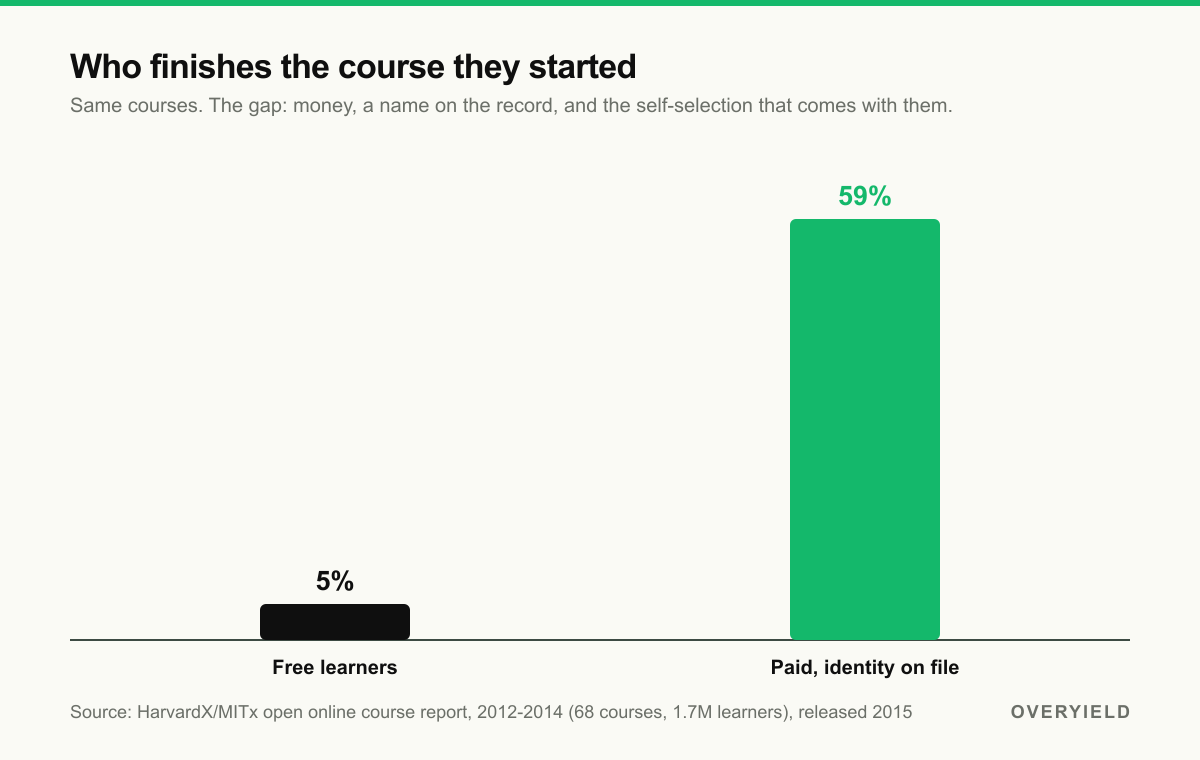 Who finishes the course they started: free learners 5%, paying verified learners 59%
And it never improved with scale. By 2017-18, across all MIT and Harvard MOOCs, completion was 3.13% and falling (Reich and Ruipérez-Valiente, Science, January 2019). Six years of better content did not move it. Content was never the constraint.
Follow-through is the constraint, and it runs through the whole economy right now. The Innermost Loop reported on August 15 that “The median company now spends $12 per employee per month on AI, and the top 1% spend $7,500.” The number is Ramp’s, from its AI Index of card spend across more than 70,000 US businesses.
That is a 625x spread between owning the tools and working them. The same letter’s companion stat two days earlier, from OpenAI usage data: the top tenth of adopters burn 8.3x the median firm’s tokens per user.
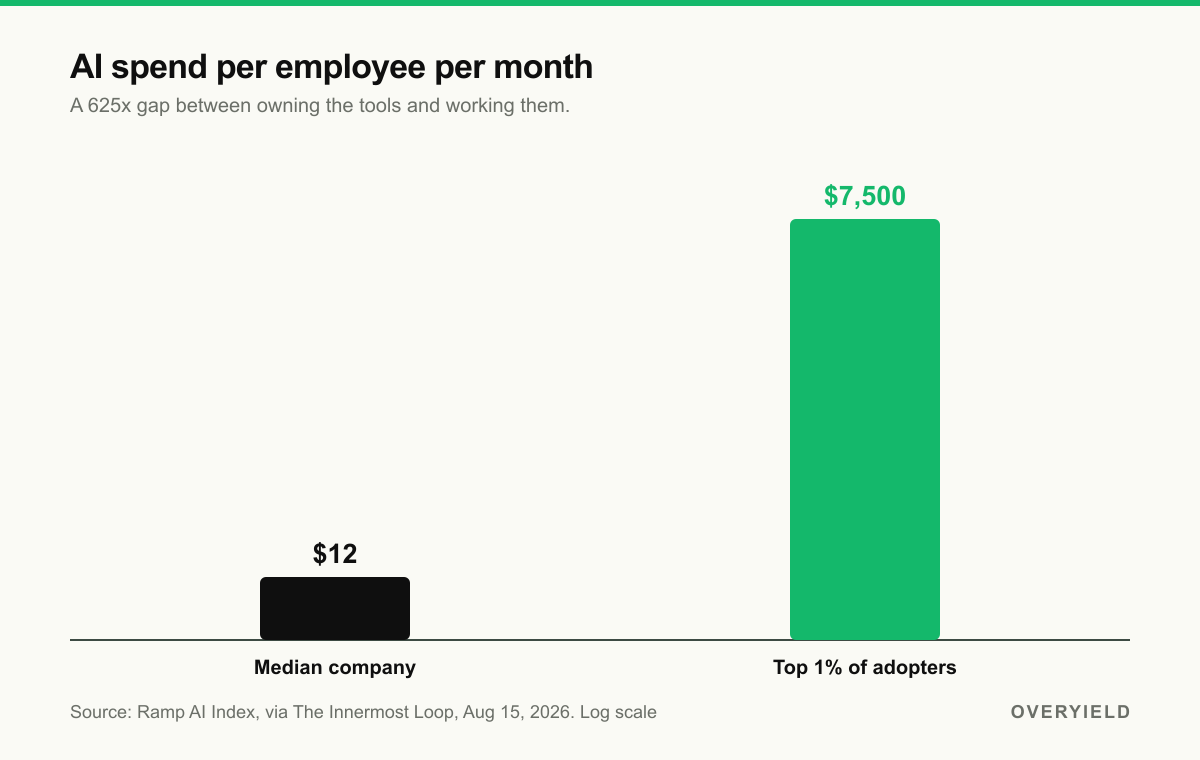 AI spend per employee per month: median company $12, top 1% $7,500
Even the people swimming in agents hit the same wall. Ben Tossell, who has spent two years living inside agent tooling, wrote this confession on August 13 about his first personal-agent phase:
“Having a shower? Make sure my agent was doing something. Going to sleep? Get my agent on something. Things I used? Zero.”
Generation is infinite. Finishing is rare. That gap has a name now: proof of work. Not the crypto kind. The human kind: dated evidence that a specific person completed a specific action.
What the consensus takes from this week: sell accountability instead of information. Become a coach. Go in-person. Build a more authentic personal brand.
What the consensus misses: that advice turns you into one more accountability provider, trading hours for clients you have to find one at a time. The sharper move sits one step down the value chain.
Thousands of creators already own the audiences and the content. None of them can prove their members did anything.
Sell THEM the proof layer, as a product.
Answers are free. Finished is for sale.
The trigger is the August 13 evidence, both halves from the same episode: AI versions of Galpin’s own programs are, by his account, good enough to start a beginner, and the money moved to whoever can show the work happened.
Creators feel that squeeze right now. Their content is cloneable.
Their completion rates are the one thing a chatbot cannot fake.
THE PLAY: THE PROOF SPRINT
Effort: medium · Cost to start: $50-100 · Time to first $: 7-14 days · Skill: beginner-plus; no-code forms and spreadsheets, offer design, outbound. No code.
A build-a-product week: one standardized product, sold twice, then rented monthly.
Buyer. An independent course or paid-community creator with at least 100 members, an existing curriculum or recurring challenge, and a promise that requires member action.
Stick to business, career, creative, or software niches; regulated outcomes (health, money, legal) are off the table.
The buyer is visible in public: Skool’s Discovery directory lists thousands of paid communities, with the owner’s profile one click away.
Pain. The creator has plenty of content and thin evidence anyone uses it. Completion means lesson views and checked boxes.
Renewals sag because members who did nothing (correctly) feel they got nothing. And the entry tier of their teaching is now free on demand from any chatbot.
More videos cannot fix any of that.
Offer. Turn one existing module into a seven-day proof sprint: one visible action per day with a defined evidence requirement, automated reminders, a creator dashboard showing who is stuck where.
The member leaves with a completion receipt recording what was done, when, with which artifacts. You install it white-label under the creator’s brand, from a template you build once.
Who pays whom. The creator pays you $399 to install the sprint and $69 a month to keep it running: hosting and reminders, one active sprint at a time, the weekly completion summary. That is your income. Their members pay you nothing and you recruit nobody.
Why it works: the receipt is the one deliverable in the creator economy that cannot be generated. A chatbot can clone the curriculum. It cannot mint evidence that Member 41 sent ten real pitches this week. The creator buys back the thing Galpin says the market pays for: proof.
The worked example. A creator sells “Find Your First Freelance Design Client”: twelve videos and a community. You convert one module into the Ten-Pitch Sprint.
Day 1: pick a niche (evidence: one sentence). Day 2: list 20 prospects (evidence: sheet link).
Day 3: write one narrow offer (evidence: the text). Days 4-6: personalize and send ten pitches (evidence: redacted screenshots), log replies.
Day 7: review and pick the next action. The receipt reports: 20 prospects researched, 10 pitches sent, replies received, calls booked if any, dates, artifact links.
A member who sends ten pitches and gets zero replies still earns an honest receipt. The system never invents a win, and that refusal is why the creator can put their name on it.
The math, modest case. Contacting 50 qualified creators with a personalized note takes about 3.3 hours. Assume exactly one says yes.
Building their sprint from your template, onboarding, and first-month support takes about 2.8 hours. You collect $468 ($399 plus the first $69).
Costs run about $38: payment processing plus your share of the form, database, and automation tools. That is $430 net for 6.1 hours: $70 an hour.
Add one or two one-time evenings before the clock starts: the demo build and the qualifier pass, both reused for every pitch after the first. After that, each renewal is $55 net.
Quiet months are minutes of upkeep; sprint weeks are real review work. A second creator from the same 50 is upside, not the model.
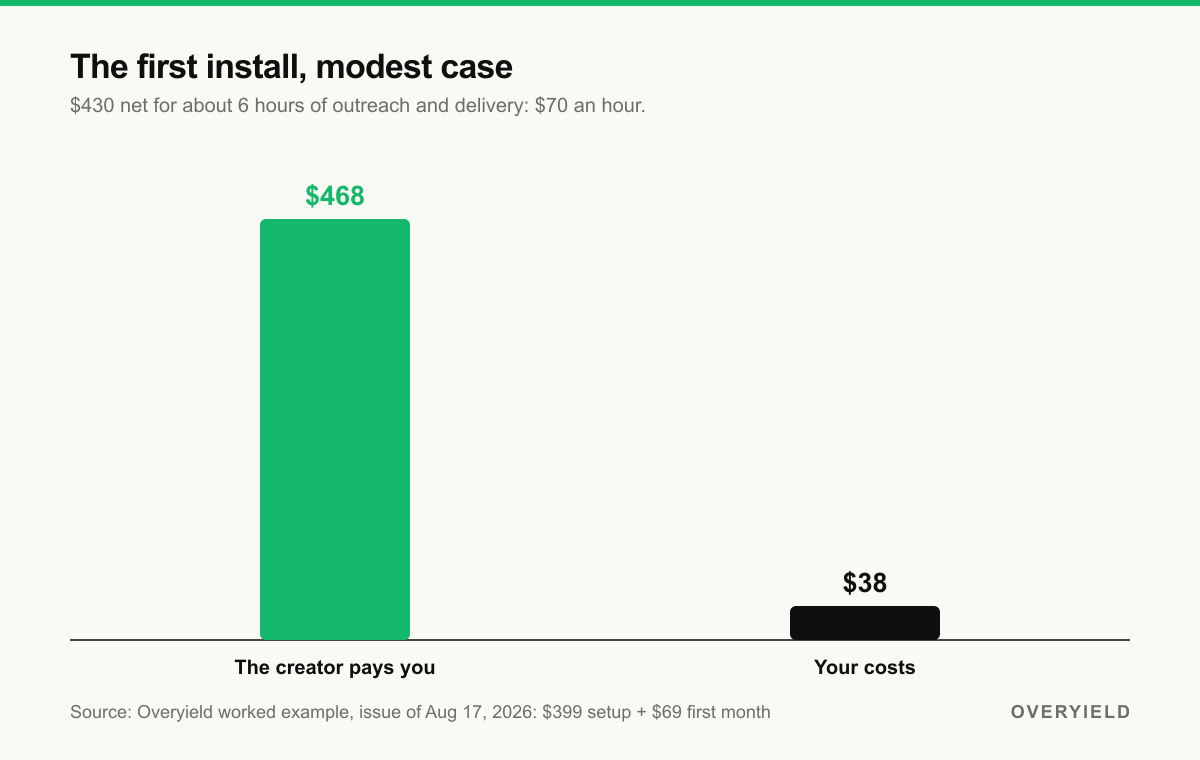 The first install, modest case: creator pays $468, your costs $38
First move (48 hours). Day one: pick one public freelance-skills community on Skool.
Build a complete fictional seven-day sprint from its visible promise, in your no-code stack, and record a 90-second walkthrough: the member’s evidence form, the dashboard, the receipt.
Day two: list 50 creators from Skool Discovery that pass the qualifier. Send the first 20 one specific note: "Your members can watch the module, but they cannot leave with a receipt showing what they implemented.
I built a seven-day proof version of one lesson: here is the 90-second demo. I install it under your brand for $399 plus $69 a month." Offer two founding installs.
No free custom builds.
The honest part. A completion receipt proves action, not income, and your copy must never blur that line. Some creators run live cohorts that already do this with humans; they are not your buyer.
Others have 100 members and 9 active ones, and $69 a month will not survive their next audit of their own tools.
The product dies if every creator gets a custom app: one sprint structure, two evidence types, one dashboard, one receipt format, or your margin is gone.
And the work has a grind in it: reviewing evidence submissions is the job, and the job is why the creator pays rather than doing it themselves.
THE TOOL (FREE)
The Proof Sprint Kit turns one static lesson into a sellable seven-day proof sprint, and hands you the whole founder sales system around it (grab it free). Inside:
- Who to pitch, who to skip: the six-check creator qualifier
- The seven-day action map: one finish line per day, watching never counts
- The evidence schema: what counts as proof, redaction rules, and what to refuse
- The reminder message pack: start, daily nudge, stall rescue, final call
- The dashboard and receipt templates: statuses, completion summary, the honest receipt
- The privacy floor: minimum data, consent lines, retention, deletion
- The founder sales pack: 50-creator tracker, outreach notes, demo script, pricing
- The worked Ten-Pitch Sprint, filled end to end
Do it in 5 minutes. Open the kit, pick any course or community you have ever bought, and write its Day 1 action and evidence line using the action map. If you cannot name observable evidence for the promise, you have found what to say in the outreach note.
A receipt a chatbot cannot mint.
Want one play like this every Monday?
Free every week, with the done-for-you kit to run it.
WHAT THIS MEANS FOR YOU
If you sell a course or run a paid community. You are the buyer, so pay yourself first: run one module through the kit this week and watch what happens to engagement when Day 3 asks for evidence. Your completion data becomes your best sales page. An AI clone of your content will never have it.
If you’re starting from zero. This play needs no audience and no code. The fictional demo sprint, built in an evening from public information, is your entire credibility requirement. Stay in one niche so your second install reuses 80% of the first.
If you already do client work. Add the sprint as a productized offer to any client who teaches or onboards people: agencies, SaaS onboarding, internal training. The mechanism is identical; the label changes.
If you keep buying courses and finishing none. Run the sprint on yourself before you spend another dollar on information. The HarvardX numbers above are about you too: put money and evidence on the line, or the 5% column is where you live.
THE CATCH
The bear case comes from the same episode as the thesis, and it deserves a straight look. Galpin’s accountability revival swung toward IN-PERSON: humans in rooms, not dashboards.
If the proof premium lands mostly on physical presence, a digital receipt layer captures less of it. My read: in-person serves the top of the market.
The thousands of online creators below that line still need a scalable answer, and this play sells to them. That is a judgment, not a receipt.
The platform risk is real and datable. Skool, Circle, Kajabi: they all live on completion and retention, and a native “action proof” feature is an obvious roadmap item.
So here is the call, and it goes on the scorecard: by August 31, 2027, at least one major creator platform ships native member-action evidence (uploads plus verifiable completion receipts, beyond lesson checkboxes).
I put it at better than even. When it ships, the surviving assets are the sprint design (which actions, which evidence, which refusals), the review queue a platform will not staff, plus the creator relationships.
Sell toward those from day one.
And do not sell completion theater. If a creator wants receipts without refusals, walk.
One inflated receipt, one fake win screenshot, and the product is dead in that niche.
The FTC’s rules on testimonials and typical results apply to how creators use these receipts in their marketing, and your engagement terms should say so.
This is not for everyone. If chasing 50 strangers and then reviewing evidence uploads at 9pm sounds unbearable, skip this one. The product is discipline, rented monthly.
HERE’S THE BOTTOM LINE
The expert information tier admitted this month that it had priced itself to zero.
What buyers still pay for is proof of work: paying, verified learners finish at 59% while free ones finish at 5%, companies that work their AI outspend the median 625 to 1, and the surviving question in every expertise market is “have you done it before?” Creators own audiences and content but cannot prove action.
For $399 plus $69 a month, you can be the one who makes their members' work visible, with a receipt no chatbot can mint.
Pick one module. Make it provable. Charge for the receipt.
New plays land Monday mornings. Subscribe free.
The locked library is bigger than this week.
This week’s play is free, and so is its kit. The Pro Vault is not: 45 plays and counting, each a complete play with the prompts, templates, and checklists to run it, and a new one banking most weeks. The essay and the kit stay free; the Vault is the compounding shelf behind them.
The deeper version is the part I’d never post publicly.
Free gives you the play; Pro gives you the deeper build.
This issue’s is The Sprint Foundry, and it is being built with the founding cohort rather than sold as finished: three complete vertical sprint templates (freelance-client, job-search, launch-your-product), the filled Ten-Pitch fixture with every form and reminder wired, the receipt generator, the pricing ladder from $399 install to multi-sprint retainers, and the objection scripts.
What is finished and on the shelf the moment you join is seven complete builds: the Spread Desk, the Pack Line, the Operator’s Edition, the Rep Desk, the Call Pack Studio, the Proof Room, and the Cleanroom.
Plus the community that opens when the founding cohort is in, and the forward-only scorecard where misses stay on the board.
The founding price never changes.
Founding members lock $129 a year, forever. The founding rate closes when the first 25 members are in. After that, the standard price rises toward $399 as the library and the scorecard grow. The Vault opens the moment your license key lands.
Join founding: $129 a year, never goes up Checkout takes a minute. Your license key arrives by email and opens the Vault.
Out-yield the average. Javier @ Overyield
Know a creator whose members watch everything and do nothing? Forward this. The receipt is the product now.
Overyield is educational, not financial, legal, or business advice.