
The client pays $500. The AI bill is a dollar.
The best model for commercial web work just got 16x cheaper, and buyers have not noticed. Hold your price and the difference is yours.
The signal (TL;DR): Between June 16 and June 25, open models took the quality lead on commercial web work while costing 5 to 16x less.
GLM 5.2 ran a $2.38 Opus 4.8 job for 44 cents on one benchmarked task (Startup Ideas Podcast, Jun 23) and took #1 on Design Arena for website design (Jun 16). Buyers of landing pages still pay prices set in the frontier era.
This week’s play: sell one fixed-price page at the old anchor, produce it for about a dollar of model spend, and keep the roughly $495 spread. The free kit to run it is below.
On June 23, the Startup Ideas Podcast priced the same job on two models: $2.38 on Opus 4.8, 44 cents on GLM 5.2. One benchmarked task, a 5x gap on the invoice.
That gap was the story of mid-June. A landing page that costs 49 cents to generate on Opus 4.8 generates for 6 cents on GLM 5.2 (AI Daily Brief, Jun 18).
Kimi K2.7 Code built landing pages 94% cheaper than Fable 5 in a single head-to-head test (TLDR AI, Jun 18). And on June 16, GLM 5.2 took the #1 spot on Design Arena for website design.
The cheap model is no longer the budget option. On that board, it is the best one.
Every AI newsletter read those receipts the same way: switch models, cut your AI bill. Useful advice, if you already carry a big AI bill.
Here is the reading that pays if you do not. The price of a landing page did not move in June. Only the cost of making one did. This week’s play: sell one fixed-price page at the anchor buyers already accept, build it for about a dollar, and keep the difference.
Free kit below. Let’s get into it.
THIS WEEK’S BIG THEME: THE ANCHOR GAP
Prices are memories. A buyer who paid $500 for a landing page last year expects to pay about $500 this year. Nobody re-audits the cost of goods behind a price they already accept.
Between June 16 and June 25, the cost of goods behind a whole class of digital deliverables collapsed, and the quality proof landed in the same window.
Execution got repriced. The receipts, all reported inside that ten-day stretch:
- GLM 5.2 ran a $2.38 Opus 4.8 task for 44 cents, roughly 5x cheaper, on one benchmarked task (Startup Ideas Podcast, Jun 23).
- A landing page for 6 cents vs 49 cents on Opus 4.8 (AI Daily Brief, Jun 18).
- Kimi K2.7 Code produced landing pages at 94% lower cost than Fable 5 in a single head-to-head test, about 16x (TLDR AI, Jun 18).
- OpenRouter’s Fusion scored within 1% of Fable 5 at roughly half the cost (AI Daily Brief, Jun 18).
- The macro line behind all of it: token prices are down 280x in 24 months (Metatrends, Jun 21).
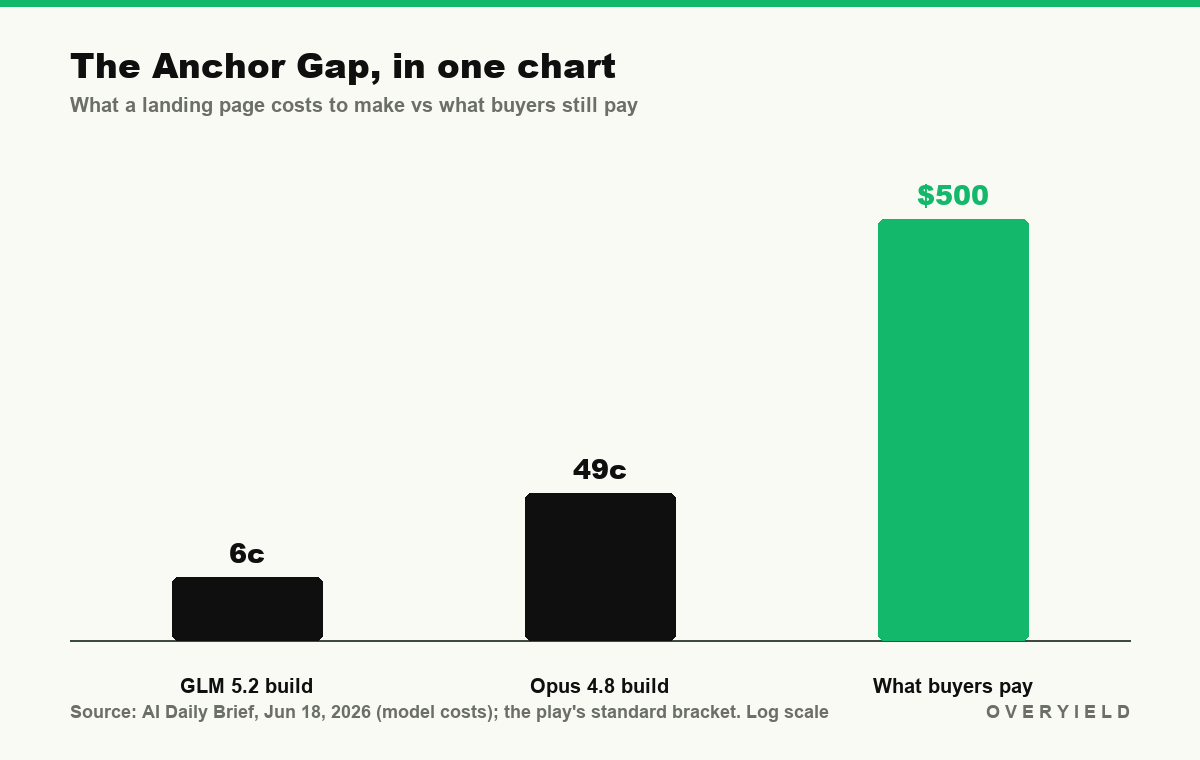 The Anchor Gap, in one chart
And the quality bar crossed at the same moment. On June 16, GLM 5.2 took #1 on Design Arena for website design, shipping Tailwind in 91% of its sessions, priced at $4.40 per million output tokens (covered AI Daily Brief, Jun 22).
Design Arena is a crowd-vote leaderboard, not a client acceptance test. But it retires the old objection that cheap means ugly.
Quality is now defensible. You still QC every unit.
What the consensus did with this. The week’s advice, nearly everywhere, was a savings story: route your workloads to the cheap models, shrink the bill.
Harvey and Fireworks even published receipts on a version of this: an open-weight worker calling Opus 4.7 as an advisor beat Opus alone on quality AND cost on their 100-task legal benchmark (AI Daily Brief, Jun 18). Fine advice.
But savings framing pays whoever already had AI costs. A beginner with no AI bill saves exactly zero.
The variant. A cost collapse only becomes income if your selling price stands still. And the selling price of a landing page is standing still, because buyers anchor to what they paid last time, not to your cost of goods.
That frozen anchor sitting on top of a collapsed cost has a name: the Anchor Gap. The move is not to pass the collapse through as a discount.
The move is to hold the anchor and keep the gap.
Hold your price. Let the cost collapse underneath it.
The missing half shipped the same week. On June 24, Chris Do spent an episode of BigDeal on exactly the skill this trade requires: bracket your prices so clients anchor high, excavate the budget before you quote, and never justify your number.
He was not talking about AI at all. That is the point.
The cost side collapsed June 16 to 23. The anchor-defense playbook landed June 24.
Nobody put the two together.
Cost stories are for buyers. Spread trades are for operators.
Who loses. Freelancers who pass the collapse through as cheaper rates, converting a once-in-a-cycle margin gift into a race to the bottom. And anyone still quoting hourly, because cheap execution turns their efficiency into the client’s discount.
Who wins. The operator who treats this like a trade: sell at the anchor, produce at open-model cost, defend the price with positioning and receipts, and respect that the window closes.
Why this exact week: before June 16 you could have cheap or defensibly good, not both with receipts. Now both halves of the trade are on the record, dated eight days apart.
THE PLAY: THE FRONTIER SPREAD
Effort: medium · Cost to start: about $20 · Time to first $: 3–10 days · Skill: beginner-plus; no code required, but you need a QC eye and plain client communication
Buyer. Founders, marketers, and creators who buy fixed-price landing pages and small marketing sites: on freelance marketplaces, in build-in-public communities on X, through productized storefronts. Their price expectations were set when this work meant human hours plus frontier model costs.
Pain. They need a page that looks credible and ships this week. Agencies quote four figures and multi-week timelines. Bottom-tier marketplace gigs are a lottery. They will happily pay $500 for fast, accountable, and good.
Offer. A fixed-price landing page or small marketing site, delivered in 72 hours: a copy pass, mobile QC, two revision rounds, and structured data included.
That last line item is worth quoting by name: “agent-ready,” meaning clean JSON-LD so AI search and shopping agents can parse the page.
The rails for machine buyers switched on in this window: Stripe’s Directory let agents find and pay businesses (Jun 22) and Shopify shipped its Universal Commerce Protocol (Jun 17).
Machine-readable pages are a forward-looking upsell sentence today. Quote it as one.
Who pays whom. The client pays you.
Quote three brackets, highest first, the way Chris Do teaches: $900 for a multi-section site with analytics and a 30-day tweak window, $500 for the standard page with the copy pass and agent-ready data, $350 for the bare single page.
Most take the middle. Never mention your costs, and never justify the number.
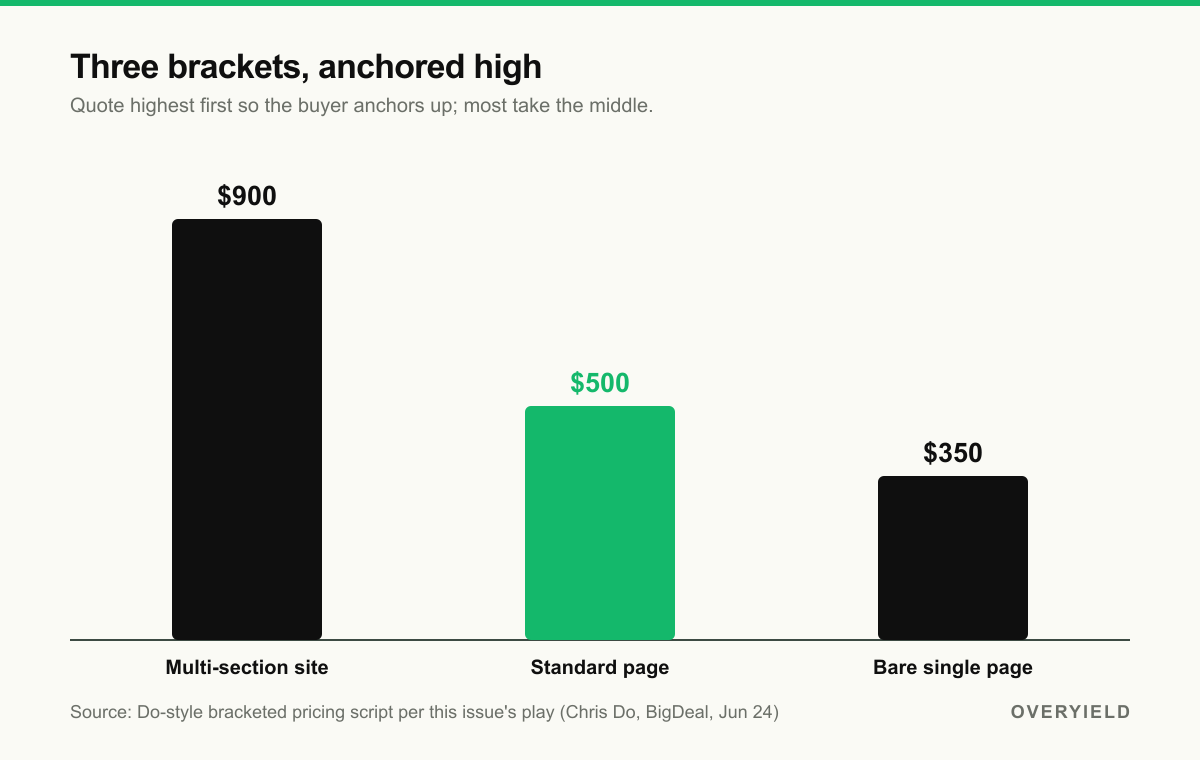 Three pricing brackets, anchored high
The proof. Publish the spread. After every delivery, log three numbers: price charged, total model cost from your OpenRouter activity page, and delivery time.
Publish the receipt anonymized. A public stack of “$500 charged, $0.87 of model spend, delivered in 71 hours” receipts is a portfolio nobody can argue with, and it compounds into the exact positioning that lets you hold the anchor.
A worked example. One gig, conservative, rounded down. A bootstrapped founder takes the $500 bracket.
Your production chain: a planning pass on a frontier model, about 40 cents; six execution runs on GLM 5.2 at about 6 cents each; a review pass on a third model family, about 15 cents. Total model spend: under a dollar.
Call your all-in cost $5 with preview hosting. Your time: 2 to 3 hours of QC, revisions, and client messages.
Gross margin: about $495.
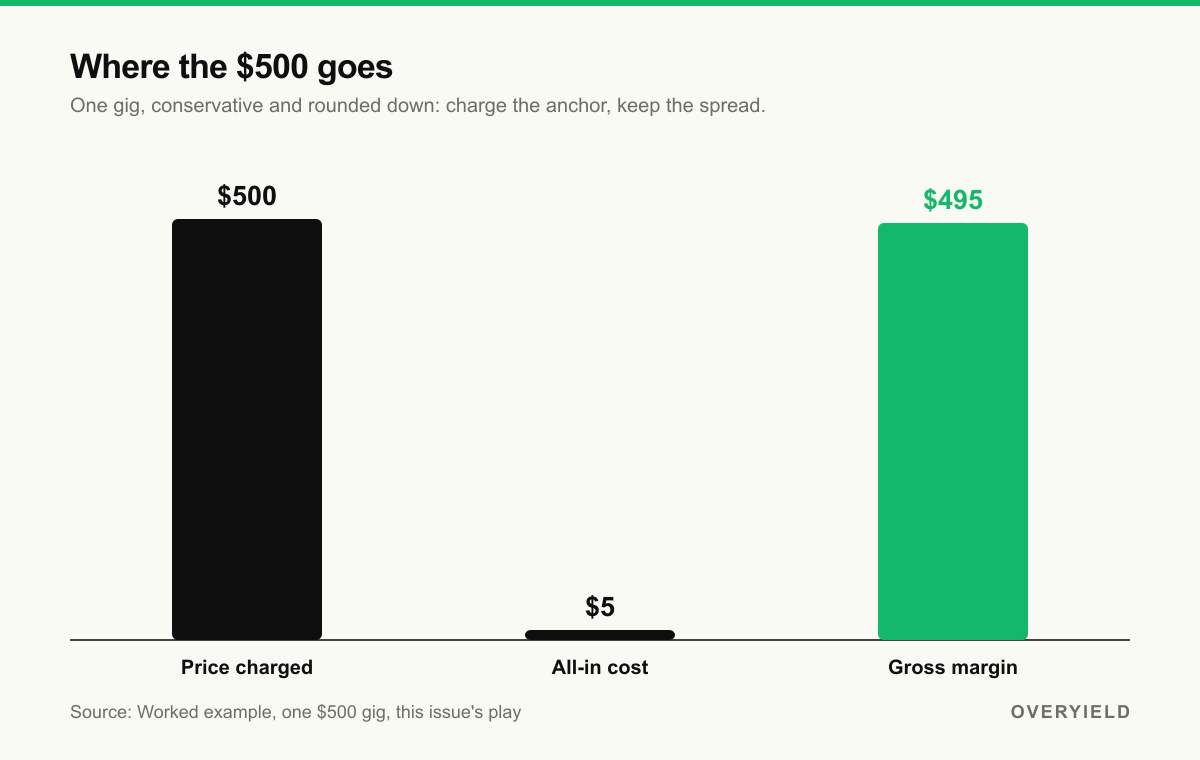 Where the $500 goes: cost, price, margin
Two honest footnotes on that math. The 2 to 3 hours does not include finding the client; winning the first gig is the actual work. And do not multiply this into a weekly portfolio number. Model one gig. Win one gig. Then talk.
First move (48 hours). Day one: load $20 into OpenRouter and run the kit’s three-model chain on a practice brief.
Rebuild the landing page of a business you know, run the 10-task mini-eval and the QC checklist, and label the result spec work.
The chain routes through OpenRouter for a reason: on June 12, Fable 5 was suspended with 90 minutes of warning (Moonshots, Jun 18). A one-vendor pipeline can die mid-delivery.
A routed one reroutes.
Day two: send this note to 10 people who plausibly need a page. Warm network first, then marketplaces and build-in-public threads:
*"I am taking on two fixed-price landing page builds this week: $500 flat, delivered in 72 hours, with a copy pass, mobile QC, two revision rounds, and structured data so AI search tools can read the page.
Before you pay anything, I will send a free one-page teardown of your current page so you can judge how I think. Want the teardown?"*
The honest part. The deliverable is almost beside the point; the trade is the margin and the window, and both have failure modes.
Open models still show gaps: weak judgment on visuals, occasional structural slop, and a fondness for inventing statistics and testimonials, which is exactly what the kit’s QC checklist exists to catch.
The quality is defensible, not indistinguishable, so never claim indistinguishable.
Routing through OpenRouter means third-party providers process your prompts: check the data-handling settings before any client-confidential material goes in.
And if you already sell pages at $2,000, this issue is not telling you to drop to $500. It is telling you to hold YOUR anchor while your cost of goods collapses underneath it.
THE TOOL (FREE)
The Spread Kit. The whole trade, packed to run (grab it free). Inside:
- the $20 OpenRouter setup
- the three-model chain (plan, execute, review) with the exact prompts
- the 10-task golden mini-eval that makes any model swap safe
- the QC checklist for open-model failure modes: invented statistics, vision gaps, broken mobile
- the Do-style bracketed pricing script (quote without ever mentioning costs)
- the outreach note with the free-teardown mechanic
- the agent-ready JSON-LD block
- the per-gig receipt template with honest attribution rules
Including a full worked example, one $500 gig from brief to published receipt, with every number shown.
Do it in 5 minutes. Open the kit, load $20 into OpenRouter, and paste the plan prompt with a practice brief. You will have a reviewable draft page before your coffee cools, and a spec-work portfolio piece by tonight.
Want one play like this every Monday?
Free every week, with the done-for-you kit to run it.
WHAT THIS MEANS FOR YOU
If you already sell web, design, or marketing deliverables. Your cost of goods just collapsed. Do not pass it through as a discount.
Re-run your unit math, hold your current anchor, and add the agent-ready line item to every quote this month. Run the 10-task mini-eval before you swap the execution model inside live client work, never mid-project without it.
If you are starting from zero. This is one of the lowest-cost entries on the board: $20 of OpenRouter credit, one practice build this weekend, ten outreach notes on Monday. One yes at $500 is a 25x return on the setup cost, and the receipt from that gig is your marketing for the next one.
If you buy these deliverables. You are the other side of this trade. Re-anchor now: ask any vendor quoting frontier-era prices what the build actually costs to produce, and watch the bracket move. The window exists because most buyers will not ask for another couple of quarters.
If you run client work on a single frontier vendor. June 12 was your warning: Fable 5 went dark with 90 minutes of notice. Route through a broker, keep a golden-task eval on file, and no outage can kill a delivery mid-gig. That habit costs an afternoon and saves a contract.
THE CATCH
The bear case first. If this reads to you like “start an AI landing-page side hustle,” you have already lost the trade, because the hustle version competes on price and the whole point is refusing to.
The margin only exists while the anchor holds, and the anchor only holds if your positioning and receipts hold it. Chris Do’s numbers move (BigDeal, Jun 24) because scarcity and proof move them, not because the pages got cheaper.
Demand did not collapse in your favor either. The cost side is solved; the client side is not. Expect the first gig to take real outreach, and expect marketplace bottom-feeders to undercut you at $50. They were always there. They are not selling what you are selling.
The macro bear is on the record too: Jeremy Grantham, on Diary of a CEO (Jun 25), called this the biggest investment bubble in American history and said AI leaders could fall 70%. Worth hearing.
But notice what this play holds: no AI equity, no GPU exposure, a $20 OpenRouter balance. The open weights are already public.
If the bubble pops, your cost of goods does not go back up.
The real clock is re-anchoring.
Every buyer who learns what pages cost now moves the anchor down, and token prices are falling roughly 10x annually (Metatrends, Jun 21), which means this exact spread narrows over the coming quarters.
The same force keeps reopening new spreads with every release. The durable asset is not this window.
It is your anchor, your receipts, and a QC harness that makes the next cheap model swappable in an afternoon. We are logging the window as a dated call on the scorecard, so you can grade us on it.
HERE’S THE BOTTOM LINE
June’s tape was plain: the cost of a page fell to cents, the quality lead flipped open-weight, and the price buyers pay never moved. This is the third beat of the arc.
June 15: prove the AI workflow paid. June 22: compile the workflow so you stop renting it.
June 29: the market just repriced the labor itself, so hold your price, swap your cost of goods, and bank the gap.
Hold the anchor. Swap the cost. Bank the spread.
New plays land Monday mornings. Subscribe free.
The locked library is already bigger than this week.
This week’s play is free. The rest of the Vault in Pro is not.
Each is a complete play with the prompts, templates, scripts, and kit to run it. The McKinsey Teardown.
Sell to AI Agents. The Agent Shelf, the Model Escape Kit, the Verified Operator.
The library grows weekly. This kit stays free to keep and run.
The done-for-you version, the Spread Desk, lives in Pro with the rest of the Vault.
The deeper version of this play is the part I would not put on the public site.
Free gives you the play. Pro gives you the deeper, done-for-you build.
This issue’s Pro upgrade: The Spread Desk. The full three-model routing configs (plan, execute, and review presets with exact model choices and OpenRouter settings), the 20-task golden-eval QC pack tuned to landing pages and marketing sites, the bracketed pricing scripts with objection lines, the gig-sourcing playbook for where fixed-price buyers actually are, and the per-gig ledger that doubles as your public proof asset.
It ships to members as a rolling build, routing configs first, and founding members set the order of the rest.
Plus the community, which opens the moment the founding cohort is in, and the forward-only scorecard, where every call we have made is still marked Pending and misses will stay on the board.
The founding price never changes.
Founding members lock $129 a year, forever. The founding rate closes when the first 25 members are in.
After that, the standard price rises toward $399 as the library and the scorecard grow, but every founding rate stays locked. One $500 gig from this issue’s worked example pays for the year nearly four times over.
Join founding: $129 a year, locked forever Checkout takes a minute. Your license key arrives by email and opens the Vault.
Out-yield the average. Javier @ Overyield
Know a freelancer still quoting by the hour? Forward this. They will owe you one.
Overyield is educational, not financial, legal, or business advice.