
Agents don't buy adjectives. Sell the measurements.
AI shopping traffic tripled in a year, and three quarters of those orders landed outside Shopify's biggest categories. The new buyer is a machine that checks fields, not feelings. The operator who fills the fields gets paid.
The signal (TL;DR): On its early-August earnings call, Shopify said AI-driven traffic to its stores has tripled in a year, and 75% of those AI-attributed orders landed outside Shopify’s top 100 categories, which Shopify called a structural advantage for small, specialized sellers.
A day earlier, a federal appeals court lifted Amazon’s block on Perplexity’s shopping assistant, finding that it is the user, not the AI, who is doing the accessing. The buyer is becoming a machine, and a machine cannot be charmed.
It checks fields. This week’s play: the Constraint Catalog Sprint, a $600 five-day service that turns ten “fits most” product pages into exact answers an agent can buy from.
The free Exact-Fit Field Kit is below.
The loud story in early August was Google. On August 5, Demis Hassabis handed off the DeepMind CEO job and became Chair of Google DeepMind and Chief Scientist of Alphabet, while keeping Isomorphic Labs.
The CEO title was not refilled: CTO Koray Kavukcuoglu took day-to-day control, reporting to Sundar Pichai.
The same day, chief scientist Jeff Dean ended a 27-year run to co-found Discovery Loop, a public benefit corporation, with Sanjay Ghemawat, Oriol Vinyals and Quoc Le.
Google is a founding investor and the cloud partner, so this is a spin-out, not a defection. GOOGL closed down 4.03% that session.
The market had already spent two weeks grading AI capital spending harshly: Alphabet’s July 22 earnings raised 2026 capex guidance to $195 to $205 billion and the stock fell 7% the next day, so the departures do not own the whole move.
On All-In’s August 8 episode, David Sacks described his reaction: "when I saw this Google News, my reaction was, and then there were two... we used to have five major companies in the hunt to be the leading frontier lab, the leading frontier model just a year ago.
Now we’re really down to just Anthropic and OpenAI."
Maybe. But you cannot invoice a duopoly.
The useful story came from an earnings call most AI newsletters skipped. Shopify put first-party numbers on what happens when software starts doing the shopping. Three quarters of those orders landed outside its biggest categories. The reason is boring. And the reason is a job.
The buyer changed species. The storefront did not.
Let’s get into it.
THIS WEEK’S BIG THEME: THE ANSWERABLE SHELF
Start with the number. AI-driven traffic to Shopify stores is up 3x year over year, per president Harley Finkelstein on the August 5 earnings call, and traditional search kept growing alongside it.
Revenue rose 34% to $3.58 billion. Operating income rose 68% to $488 million, because operating expenses rose only 21%.
Read that middle number precisely: total costs including cost of revenues rose about 30%, and gross margin slipped from 48.6% to 47.7%.
The profit came from holding operating expenses to 34% of revenue, down from 38% a year ago, not from delivering anything cheaper.
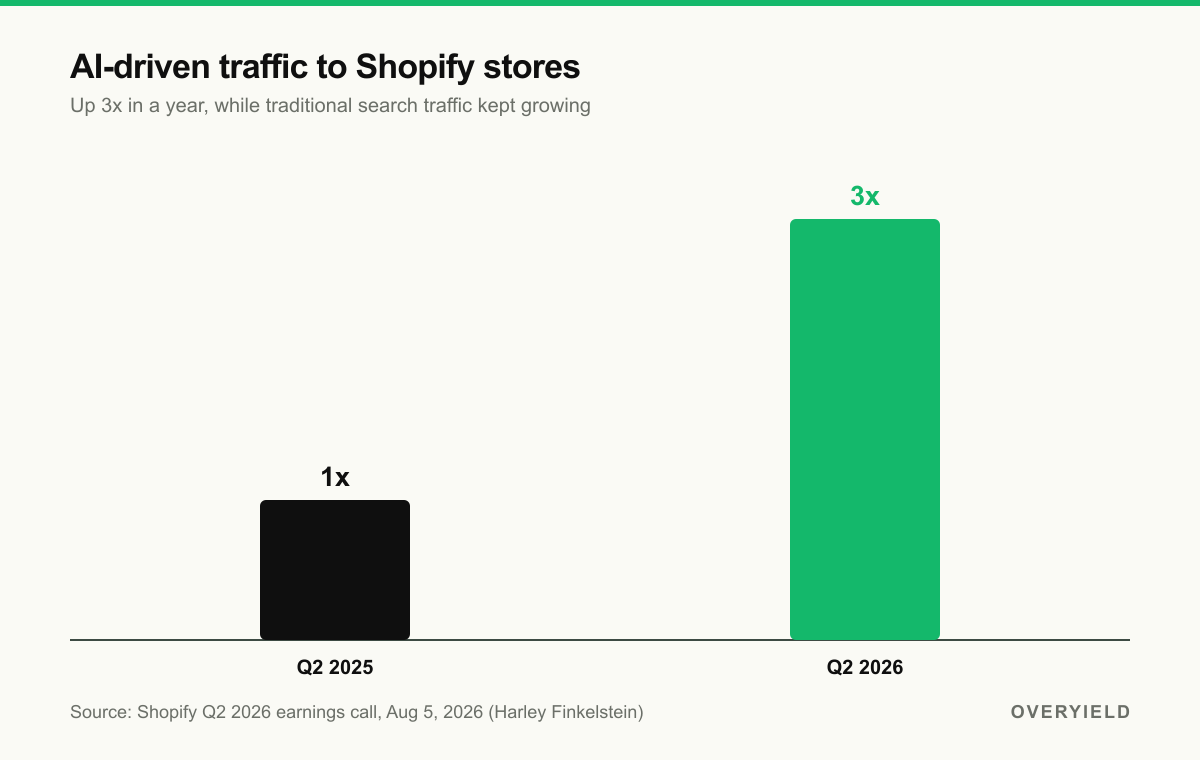 AI-driven traffic to Shopify stores, up 3x in a year
Inside that quarter is the number worth taping to the wall: 75% of AI-attributed orders came from outside Shopify’s top 100 categories, which management called a structural advantage for small, specialized, independent businesses.
Why would machine buyers favor the small shop? Finkelstein put it carefully, and the hedge is the honest part:
“Early indications show that AI search has been particularly helpful to some of the smaller brands that form the long tail of commerce.”
Here is the mechanism. A human types “car seat” and scrolls whatever ranked.
An agent gets the real question: the best car seat that fits three across a sedan.
It splits that into constraints, then makes multiple calls into the store’s structured catalog data, hunting for the one product that satisfies the whole set at once. Popularity cannot answer a width question.
A field can.
The rest of that week kept feeding the same shift.
On August 4 the Ninth Circuit vacated Amazon’s injunction against Perplexity and sent the case back down, ruling that on this record Amazon is unlikely to win its Computer Fraud and Abuse Act claim because it is the user who accesses Amazon’s computers.
The assistant, the court said, is a tool, not a person for statutory purposes. Reuters called it the first federal appellate ruling on whether AI agents may access online platforms for a user.
The panel drew its own limits: it does “not establish a new legal regime governing agentic AI,” and left contract, terms-of-service and tort claims fully alive. (Amazon.com Services, LLC v.
Perplexity AI, Inc., No. 26-1444, 9th Cir., Aug. 4, 2026.) More people are about to ask a machine what to buy.
What the consensus took from this: do GEO. Publish authority content, add schema, become the source AI engines cite. A whole consulting category rebranded in a month.
What the consensus missed: for a product seller, citation is not the binding constraint. Answerability is. An agent that cannot verify whether your product fits the buyer’s exact model does not argue with your marketing. It skips you and buys from the store that answered.
Open any small store today and the shelf talks like an ad. Lightweight. Universal. Fits most. The dimensions live in a PDF. The compatibility list lives in the founder’s head. Units change between variants. To a person, that is atmosphere. To an agent, it is a dead end.
So the scarce asset now has a shape: the answerable shelf. AI made recommendations abundant.
It made verified, normalized, constraint-complete product data scarce. Ad position mattered because humans read top to bottom.
A constraint checker does not read top to bottom. It reads fields, and almost nobody’s fields are filled.
An agent cannot be charmed. It can only be answered.
THE PLAY: THE CONSTRAINT CATALOG SPRINT
Effort: medium · Cost to start: $0-50 · Time to first $: 7-14 days · Skill: careful research, spreadsheets, basic Shopify, outbound sales. Beginner-plus.
A service week: no code, no inventory, one buyer type.
Buyer. An independent Shopify merchant with 20 to 200 products in a category where fit decides the purchase: camera accessories, desk and storage hardware, bike gear, hobby components.
Skip medical, baby, electrical, and anything safety-critical. The buyer is visible in public: search Shop.app for a constraint-heavy category and every product page leads to an independent store with a contact path.
Pain. Their best shoppers ask compound questions, and their pages answer with adjectives. Specs sit in PDFs, prose, and mismatched units.
Compatibility is implied, never stated. Shopify’s own Catalog will syndicate whatever fields exist.
The fields do not exist. Ad spend cannot fix that gap, and the fastest-growing traffic source reads fields first.
Offer. Your ten bestsellers, answerable for exact-fit questions, in five business days.
You build a constraint dictionary for the category, normalize every value against the merchant’s own manuals and spec sheets, mark what is unknown, and deliver Shopify metafields plus a plain-language fits / does not fit block for each page.
You never invent a fact. Unknowns ship labeled unknown.
Who pays whom. The merchant pays you $600 up front for the ten-SKU pilot. That is your income. Your costs are about $20 of payment processing and $20 of AI and spreadsheet tooling. $560 net to you.
The math, modest case. Qualifying and contacting 50 merchants from Shop.app takes about 6 hours. Assume exactly one says yes.
Delivery on ten SKUs takes about 4.5 hours. That is 10.5 hours for $560, which is $53 an hour, before any follow-on.
If the pilot lands, the 25-SKU version quotes at $1,000. Do not model more than one pilot per 50 contacts.
The offer either survives contact with merchants or it does not.
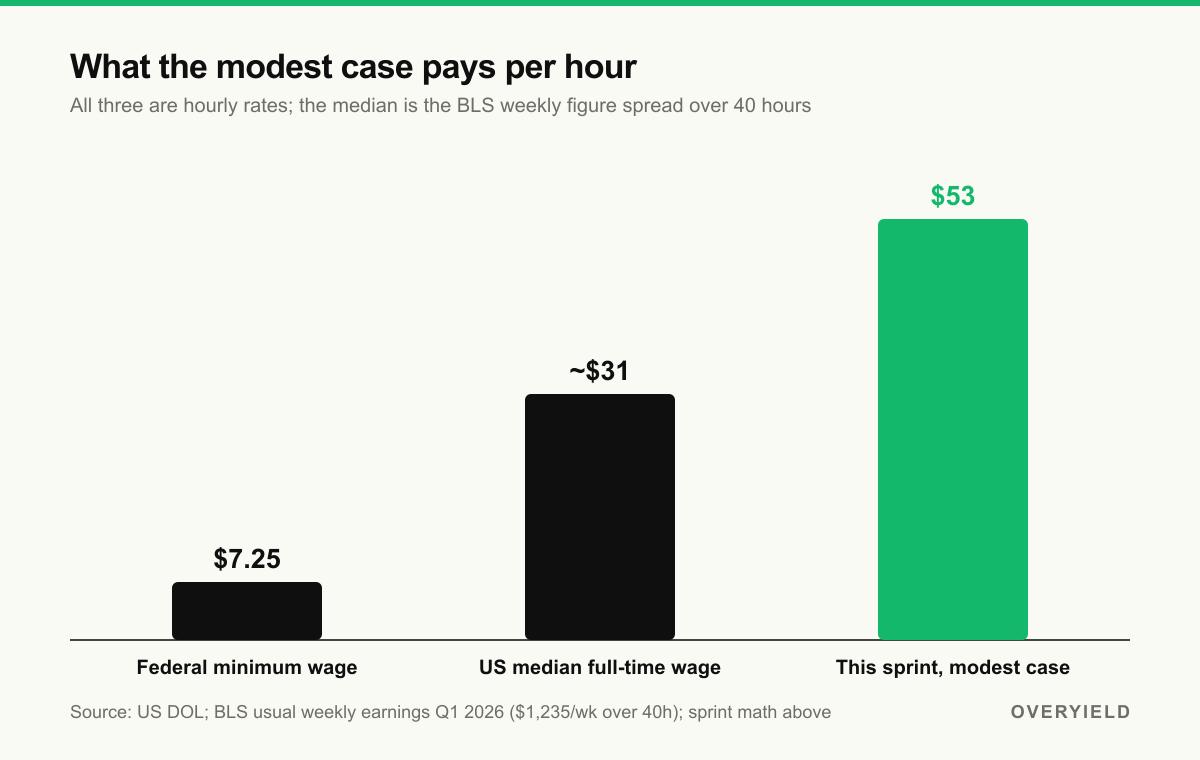 What the modest case pays per hour
The worked example. FieldFrame, a hypothetical camera-gear store, sells a cage its page calls “a lightweight universal cage for mirrorless creators.” The buyer’s actual question: which cage fits a Nova M4S, keeps the battery door usable, takes a 1/4-20 vertical mount, and stays under 200 grams.
From the merchant’s own manual, the sprint produces fields: compatible with M4 and M4S, not the M3, weight 178 g, battery door clear, mount 1/4-20. The page gains one block a machine and a human can both read.
Fits: Nova M4, M4S. Does not fit: Nova M3. Weight: 178 g.
Mount: 1/4-20 vertical. Battery door: stays clear.
And if the manual never states battery clearance, the field ships as unknown. That honesty is why the merchant can trust the other nine rows.
First move (48 hours). Day one: pick camera accessories. Pull 50 independent stores from Shop.app.
For ten of them, write down three exact-fit questions their pages cannot answer.
Day two: build the one-SKU sample from public data, screenshot it, and send the first 20 merchants one line: "Shopify already pushes your catalog to ChatGPT and Google AI Mode for free. It can only push what you gave it.
Your page says universal, and there is no field anywhere in your store for compatible bodies, mount thread, or battery clearance, so the agent skips you.
I will make your ten bestsellers exact-fit answerable in five days for $600." Sell the pilot, not a free audit.
The honest part. Structured data does not guarantee a recommendation or a sale. Shopify’s 3x proves the channel is growing, not that every clean catalog wins.
Some merchants already keep excellent metafields and owe you nothing. Others have source data so thin that the honest first deliverable is a list of unknowns.
And the work is tedious on purpose. Normalizing units and refusing to guess is exactly the part a merchant keeps postponing, which is why it pays.
THE TOOL (FREE)
The Exact-Fit Field Kit turns one vague product page into a source-backed constraint record, and hands you the whole sprint skeleton (grab it free). Inside:
- the merchant qualifier: six checks that pick stores worth pitching
- ten buyer query cards: compound questions in the customer’s own words
- the constraint dictionary template, with the no-inference rule built in
- the source register and normalization sheet: every value traced, every unknown labeled
- the Shopify metafield map and import-ready CSV layout
- the fits / does not fit page-block builder
- the traceability check: five questions per product, each answered or marked cannot-verify
- the outreach note and the $600 pilot script, with when to say no
Do it in 5 minutes. Open the kit, pick one real product from any store you like, and fill the constraint dictionary from its public page alone. The gaps you hit are the sales pitch.
The sample is the demo. The unknowns are the trust.
Want one play like this every Monday?
Free every week, with the done-for-you kit to run it.
WHAT THIS MEANS FOR YOU
If you run an online store. You are the buyer, so pay yourself first: run the sprint on your own ten bestsellers this week. The channel you are optimizing for is the one Shopify said on August 5 tripled year over year.
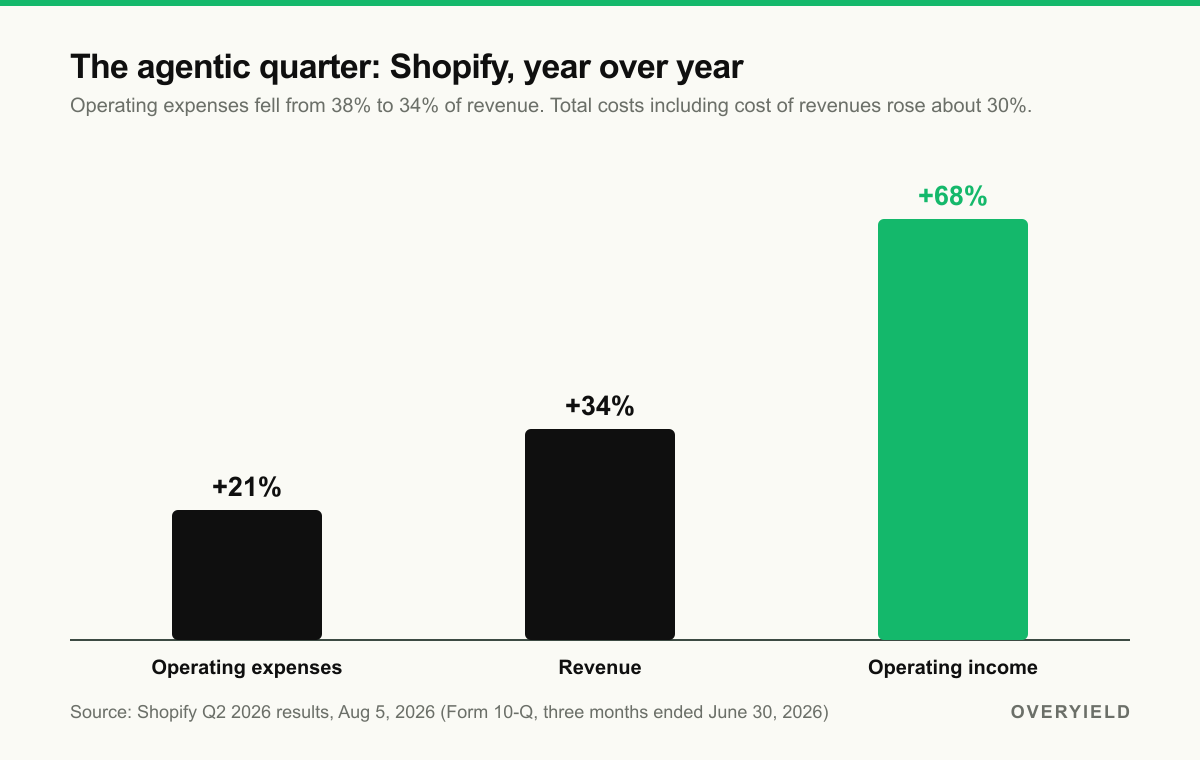 The agentic quarter: operating expenses up 21%, operating income up 68%
If you’re starting from zero. This play needs no portfolio and no code. Your first one-SKU sample, built from public data in an evening, is the entire credibility requirement. Specialize in one category so the second sprint reuses the first dictionary.
If you already do client work. Add the sprint as a productized entry offer. Your SEO and ads clients own the gap this issue describes, and the deliverable makes every other service you sell measurably better.
If you sell GEO or content services. Citation without answerability is half the job. The article gets the brand mentioned; the fields get the product bought. Bundle both and you stop competing with every rebranded SEO shop.
THE CATCH
Keep the size honest. Three-x growth compounds from a small base, and Shopify was explicit on the call that AI search complements traditional search rather than replacing it: both grew in the quarter.
Search still pays the rent. A merchant should not cut ads to fund fields; the fields make the ads convert better.
The window is not the one you think. Shopify already shipped the pipe.
Agentic Storefronts went live and auto-enabled for eligible stores on March 24, 2026, and the Spring '26 Edition on June 17, 2026 made Shopify Catalog the native structured-data layer feeding ChatGPT, Copilot, Google AI Mode and the Shop app.
No app, no feed, no integration, free. That is the reason this job exists rather than the reason it expires: when distribution costs nothing, the only variable left is what goes into the pipe.
Shopify’s own published guidance still tells merchants to do that part by hand: group variants under parent records, use “men’s insulated winter boots” instead of “footwear”, replace marketing copy with literal spec fields, keep price and inventory real-time.
Catalog cleans and syndicates what you submit. It does not invent a compatibility list that only exists in a PDF manual.
So here is the call that is actually open, and it goes on the scorecard: by January 31, 2027, Shopify will not ship a native tool that rewrites a merchant’s existing product copy and variant structure into verified exact-fit fields sourced from that merchant’s own manuals.
If it ships, that is a miss and it stays on the board. When it lands, the auto-draft still needs a human who verifies against the manual and owns the unknowns.
Sell toward that seat: the category dictionary and the merchant’s trust are the assets the platform cannot auto-generate.
And the macro bear is pacing the room.
Alphabet raised its 2026 capital-spending guidance to $195 to $205 billion at its July 22 earnings, and the market read it as a warning rather than a flex: the stock fell 7% the next session, and the August 5 DeepMind departures took another 4% off.
If capital gets expensive, AI budgets shrink.
This play is smaller than that fight: the buyer is a merchant with inventory and customers, not a startup with runway, and the deliverable makes existing traffic convert rather than adding a new bill.
But a recession shrinks every pilot budget, including a $600 one.
This is not for everyone. If reading a spec sheet twice to catch a unit mismatch sounds unbearable, skip this one. The product is care, applied to ten pages.
HERE’S THE BOTTOM LINE
Shopify put numbers on the shift: AI-driven shopping traffic tripled in a year, three quarters of those orders landed outside its top 100 categories, and a federal appeals court ruled on August 4 that an agent’s shopping is its user’s shopping.
Machines resolve constraints against fields, and most product pages still sell adjectives.
For 6 hours of outreach and an afternoon of careful work, you can be the one who fills the fields, at $600 a sprint, with the 25-SKU follow-on waiting.
Pick a category. Fix ten pages. Charge $600.
New plays land Monday mornings. Subscribe free.
The locked library is bigger than this week.
This week’s play is free. The Pro Vault is not: 45 plays and counting, each a complete play with the prompts, templates, and checklists to run it, with a new one banking most weeks. The essay always stays free. The runnable kit retires into the Vault when the next issue ships.
The deeper version is the part I’d never post publicly.
Free gives you the play; Pro gives you the deeper build.
This issue’s is The Spec Shop, and I am starting it this week with the founding cohort rather than pretending it is finished: three category constraint dictionaries (camera accessories, desk and storage hardware, bike gear), the filled FieldFrame fixture with every field traced to a source, the metafield import pack, the outreach-to-retainer pricing ladder with objection scripts, and the merchant QA checklist.
What is finished and on the shelf the moment you join is seven complete builds: the Spread Desk, the Pack Line, the Operator’s Edition, the Rep Desk, the Call Pack Studio, the Proof Room, and the Cleanroom.
Plus the community that opens when the founding cohort is in, and the forward-only scorecard where misses stay on the board.
The founding price never changes.
Founding members lock $129 a year, forever. The founding rate closes when the first 25 members are in. After that, the standard price rises toward $399 as the library and the scorecard grow. The Vault opens the moment your license key lands.
Join founding: $129 a year, locked forever Checkout takes a minute. Your license key arrives by email and opens the Vault.
Out-yield the average. Javier @ Overyield
Know someone selling online whose bestseller page says “fits most”? Forward this. Their next customer might be a machine.
Overyield is educational, not financial, legal, or business advice.