
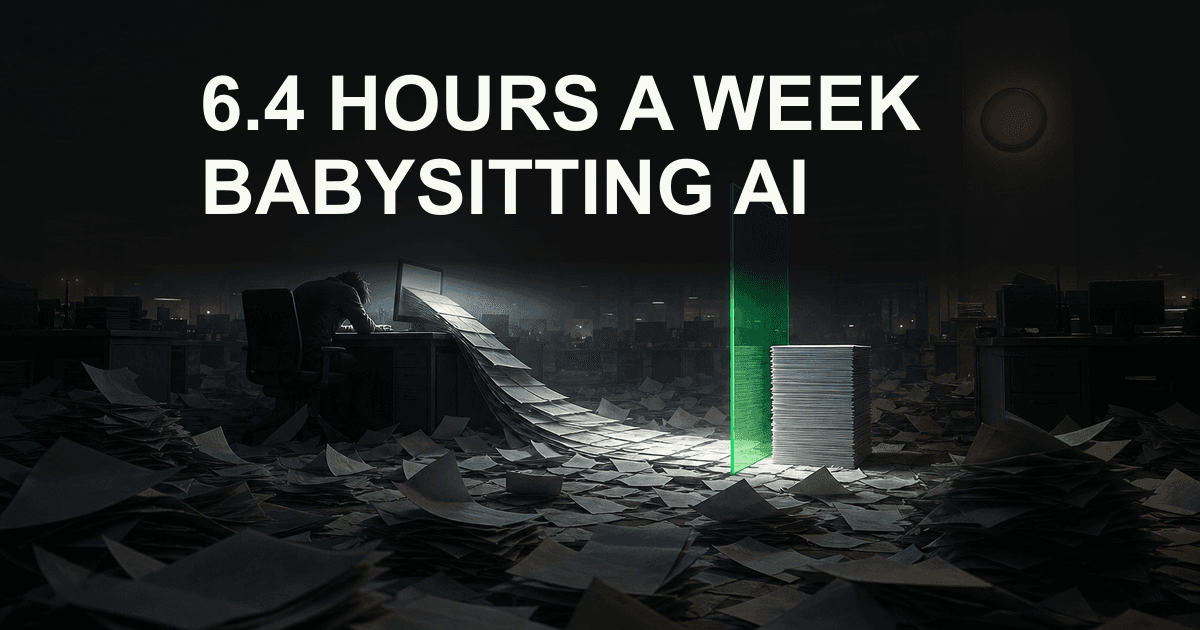
Workers lose 6.4 hours a week babysitting AI. Sell the fix for $149.
Fable 5 vanished for 19 days and repriced twice in one week. The layer above the model held its value the whole time, and you can package and sell it.
The signal (TL;DR): Fable 5 came back on July 1 after 19 days offline, rationed to paid users with half of weekly usage subsidized through July 7 (later extended to July 12).
Sonnet 5 launched June 30 at $2/$10 per million tokens, a discount with a printed expiry of August 31. The model layer is rented, rationed, and repriceable.
The layer above it is where workers bleed: 6.4 reported hours a week babysitting AI (Glean, via AI Daily Brief, Jun 26).
This week’s play: package one workflow you know cold into a sellable skill pack, a spec plus a pre-loaded context file plus a 10-case eval, priced $99-$249 with zero marginal cost per sale. The free kit to build yours is below.
On July 1, Fable 5 came back online. It had been dark for 19 days, suspended on June 12, restored after Commerce lifted the export controls (TLDR AI, Jul 1).
And it returned rationed: paid users first, with a temporary subsidy covering half of weekly usage through July 7, later extended to July 12 (Ben’s Bites, Jul 2).
The make-money-with-AI internet reacted on cue.
Chris Koerner’s July 2 issue is five service businesses to start on the returned model: legacy migrations at $30K-$70K, catch-up bookkeeping at $3,500-$10K, productized design retainers. Expect that take everywhere this week.
Fable is back, go sell services on top of it.
Read the 19 days differently. Every one of those service businesses parks its income on a layer that just proved it can vanish overnight and reprice twice in one week.
The thing that held its value through the whole blackout sits one layer up: the packaged workflow. The spec, the context, the eval.
This week’s play is to package one and sell it many times.
Free kit below. Let’s get into it.
THIS WEEK’S BIG THEME: THE LAYER THAT HELD
For 19 days, the most capable model on the market did not exist for the people who built on it. That is worth slowing down for, because the blackout ran a controlled experiment nobody would have volunteered for: it showed exactly which layer of the AI stack you actually own.
The model layer is rented. Fable 5 was suspended June 12 with the whole market watching and came back July 1 (AI Daily Brief, Jul 1). Nobody who built on it got a vote on either date.
It is rationed. The comeback ran paid users first, with usage subsidized at 50% through July 7 as first announced, later extended to July 12 (Ben’s Bites, Jul 2).
Mythos 5 shipped to roughly 100 vetted critical-infrastructure organizations and nobody else (TechCrunch, Jun 26). GPT-5.6 sits in a limited preview handpicked with the US government (Moonshots, Jun 29).
Frontier capability is now allocated, not just priced.
And it is repriceable. Sonnet 5 launched June 30 at $2/$10 per million tokens, pitched explicitly as a cheaper way to run agents, with the discount expiring August 31 and the price stepping up to $3/$15 (TechCrunch, Jun 30).
The fine print cuts the other way: it burns roughly 40% more output tokens and about 3x the agentic turns of Sonnet 4.6 (AI Daily Brief, Jul 1). Sticker price is not task price.
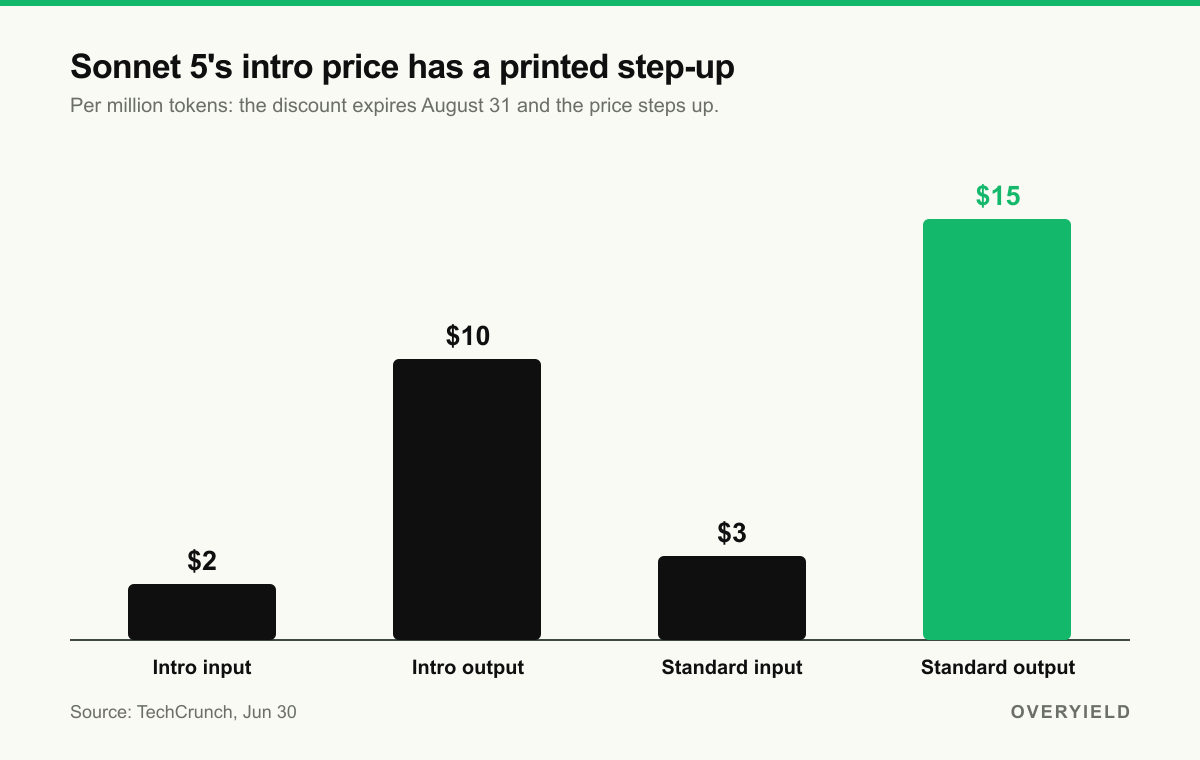 Sonnet 5 intro vs standard token pricing
So the ground floor is rented, rationed, and repriceable. Now look one layer up, where the working hours actually go.
The layer above the model is where workers bleed. Glean’s numbers, via AI Daily Brief (Jun 26): workers report saving 11 hours a week with AI, then losing 6.4 of them back to bot-sitting. Feeding context.
Verifying outputs. Cleaning up failures.
And 60% rerun the same prompts across tools, paying the same setup tax again and again. NLW’s June 28 episode added the sharpest line item: 2.4 hours a week spent just organizing AI context.
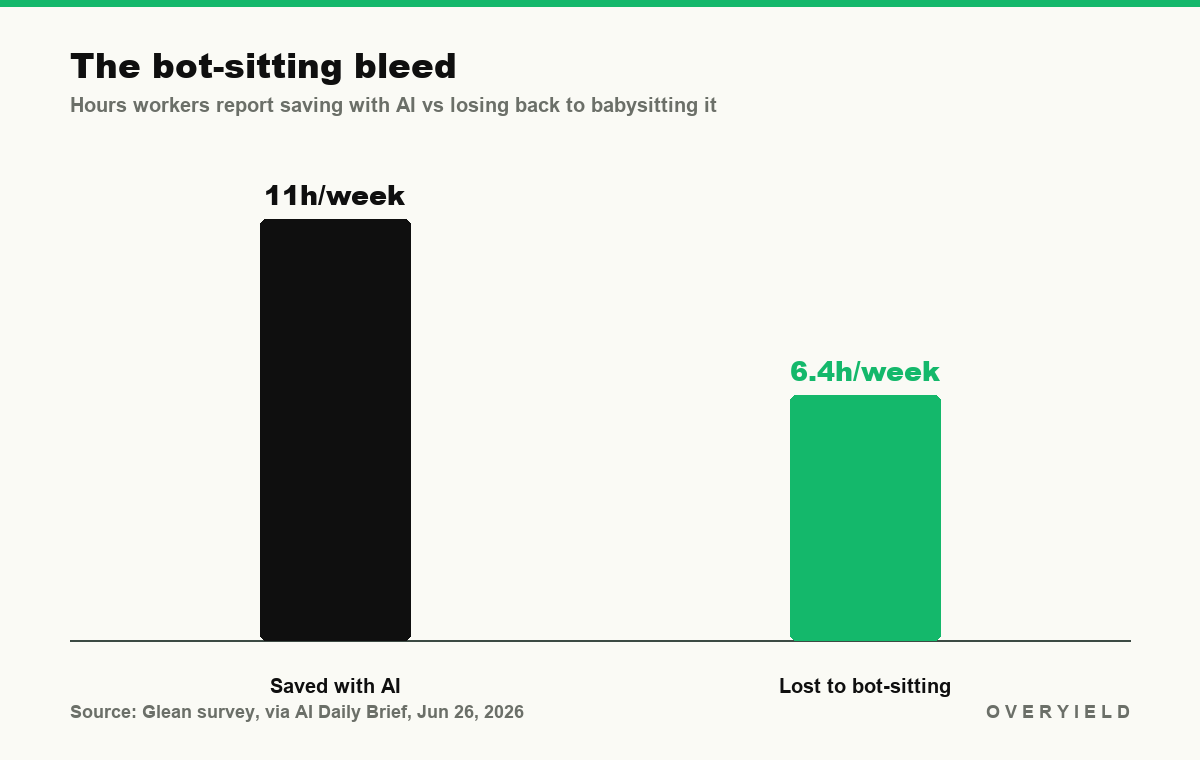 The bot-sitting bleed
The same episode named the operator response. The Capability Overhang Playbook (Jun 28): turn your context portfolio into a portable asset, and package recurring work as transferable skills. Ben’s Bites landed on the same point on July 2: effective agent deployment comes down to the context and tools you hand the model, and raw capability matters less than everyone assumed.
Now put the two halves together.
Here is what held. Through 19 days of blackout and two reprices in one week, a written spec did not lose a cent of value. Neither did a curated context file, or a 10-case eval.
Those assets ran on the old model, run on the returned one, and will run on whatever ships in September. That is not a statistic anyone reported.
It is a mechanism you can inspect: the volatile layer and the durable layer came apart in public.
The spec survived the blackout. The subscription did not.
The buyers are already telling you they pay for this layer. Lenny’s Newsletter (Jun 30) showed top product managers building reusable “skills” for their repeated tasks and wiring MCP connectors into Figma, Amplitude, and PostHog, with execs now expecting AI to complete entire tasks, and that issue funnels into a paid course with steep discounts.
This audience pays four figures to learn packaged AI capability. Almost nobody sells them the finished article: the workflow itself, packaged and verified.
Why the packaged form sells. Greg Isenberg’s July 1 solo episode: what makes an agent buyable is the trust wrapper. The spec, the approvals, the evals, the handoff rules. The wrapper is the product.
Models are rented. Workflows are owned.
Who loses. Anyone whose entire income shape is metered hours on a rented layer: the service operator whose delivery dies with the next blackout, the power user whose edge gets rebuilt from scratch every Monday.
Who wins. The person who owns assets one layer up: packaged specs, context files, and evals that survive every model swap and sell at zero marginal cost.
THE PLAY: THE SKILL PACK
Effort: medium · Cost to start: under $30 · Time to first $: 7–14 days · Skill: you must know one workflow cold; no code needed for the default tier
Buyer. High-wage professionals who already run AI hard, in one vertical: product managers, recruiters, financial analysts, RevOps leads.
The Anthropic Economic Index puts high-wage roles at up to 2.5x the token consumption of everyone else (TLDR AI, Jun 29). They buy as individuals or expense it in one click.
Not agencies. Not local SMBs.
Pain. The 6.4 reported hours a week of bot-sitting (Glean, via AI Daily Brief, Jun 26), and the 60% who rebuild the same prompts across tools. They do not want a course, and they will not spend three weekends building a harness. They want the workflow to just run.
Offer. One workflow, packaged into a skill pack with three components:
- The spec sheet. Trigger, required inputs, context, tools, approval points, escalation rules, success criteria. This is Isenberg’s minimum-viable-agent frame (Startup Ideas Podcast, Jul 1), written down instead of improvised.
- The pre-loaded context file. The definitions, formats, gold examples, and edge cases the buyer would otherwise feed in by hand, week after week. This is the asset that kills their bot-sitting hours.
- The 10-case eval. Ten realistic inputs with known-good outputs. The buyer runs it once to verify the pack works on their model, and reruns it after every model swap. It is the pack’s warranty label.
Default packaging is a paste-in bundle that works in any frontier chat: no installs, no integrations. A Claude skill or an MCP server version is the upgrade tier, not the requirement. Sellers who lead with MCP stall, and so do their buyers.
Who pays whom. The buyer pays you: $99-$249, one time, through a Lemon Squeezy or Gumroad checkout. There is no skill-pack marketplace to submit to, which cuts both ways: distribution is on you, and the shelf is nearly empty.
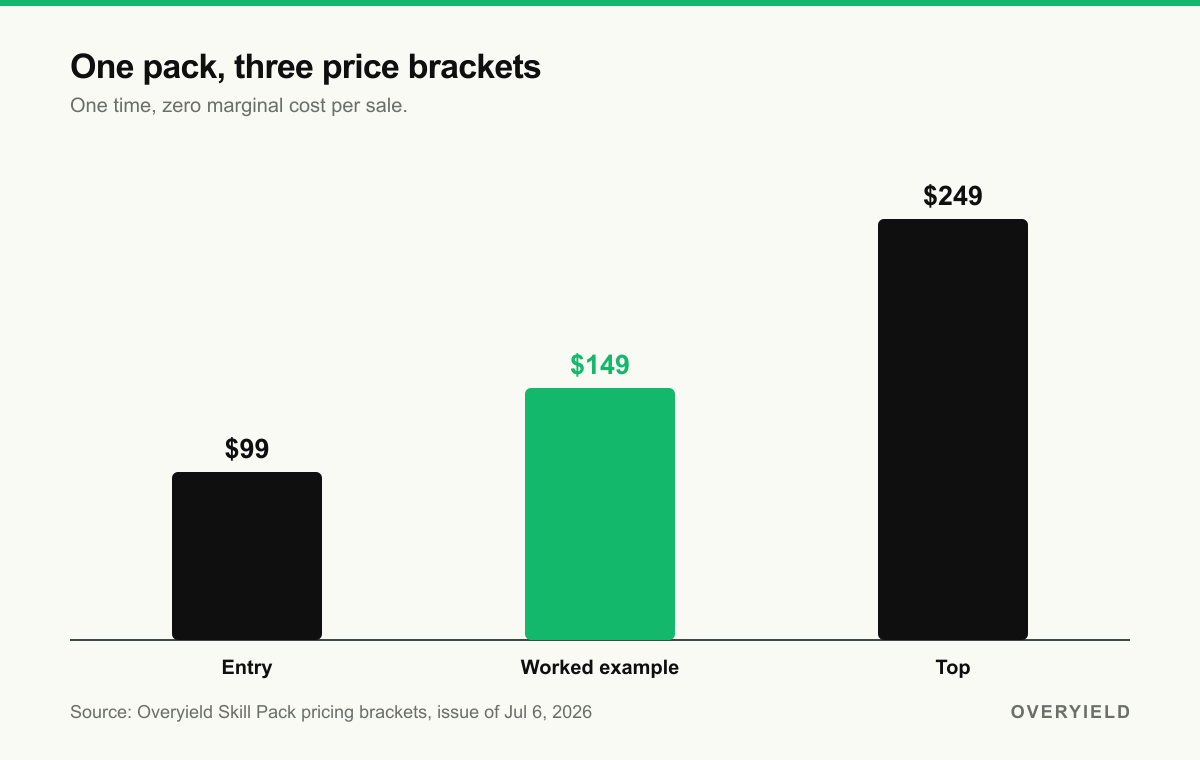 Skill pack price brackets
The proof. Publish the pack’s own 10-case eval results as the sales page. Model name, version, date, ten rows, pass or fail. One honest table does more selling than any adjective, and nobody in this category is publishing tables yet.
A worked example. Conservative, one unit, rounded down. A RevOps analyst has run the same Monday pipeline review for two years: CRM export in, a summary of stage movement, stalled deals, and risk flags out.
She packages it. The spec: trigger is the Monday export; escalation rule is any deal over $50K moving backward gets flagged for a human, never auto-summarized.
The context file: stage definitions, win-rate benchmarks, the exact output format. The eval: ten sample exports with known-correct outputs.
Build time: 10-12 hours across a week, because she already knows the workflow cold. Eval-testing spend: under $10 at Sonnet 5’s intro pricing (TechCrunch, Jun 30).
She lists The Pipeline Review Pack at $149 with the eval table on the page, posts one teardown, and shares it in two RevOps communities.
Modest case: 5 sales in month one. That is $745 gross, call it $650 after platform fees.
First dollar is one sale, achievable inside the week. The upside band if the teardown post travels: 15-30 sales, $2,235-$4,470.
Do not model that. And do not multiply packs into portfolio math.
One pack, sold honestly, then decide.
The buyer’s napkin, for the sales page: at a $60-an-hour loaded rate, killing even 2 of those reported 6.4 weekly hours is $120 a week. Against $149 one time, the pack pays for itself in under two weeks. Their math, on their numbers. You never promise the hours.
First move (48 hours). Day one: pick the workflow. The test: you have run it 50 or more times, the trigger is definable, and the output is checkable against criteria you can write down.
Draft the spec sheet, assemble the context file, and write the 10 eval cases using the kit below. Run the eval and log the results.
Day two: put the listing up with the eval table on the page, then publish this post where your buyers congregate (one community, one subreddit, your own profile):
*"I ran [the workflow] every Monday for two years. The old way took me about 3 hours: [the two or three manual steps].
The packaged way takes about 40 minutes, and the output gets checked against a 10-case eval instead of my mood. I packaged the whole thing: the spec, the pre-loaded context file, and the eval set.
Paste it into Claude or ChatGPT and run it today: [link]. The full eval results are on the page.
If your version of this workflow is different, describe it in the comments and I will tell you straight whether the pack fits."*
The honest part. The Remote Labor Index found the best model completes 16.1% of freelance tasks at professional quality (via AI Daily Brief, Jul 2). Read that as the play’s boundary, and as its sales pitch.
Most workflows do not pack. This works only when you scope one narrow workflow into the 16% and prove it with the eval.
If you cannot write ten checkable test cases, the workflow is not packable yet; pick another.
Distribution is the other real cost: no marketplace will shelve you, and Lenny’s four-figure course receipts prove willingness to pay, not that packs sell themselves. Budget an hour a week for buyer questions.
And expect copycats: the moat is the eval, the update cadence, and being first with a table, never secrecy.
THE TOOL (FREE)
The Skill Pack Builder. One workflow, packaged end to end (grab it free). Inside:
- the packability scorecard that kills weak candidates before you sink a weekend
- the spec-sheet template, with a fully filled example
- the context-file checklist and extraction prompt
- the 10-case eval rubric with the two integrity traps
- the paste-in packaging structure
- the $99/$149/$249 pricing brackets
- the listing template with the eval-table format
- the teardown post that does the selling, plus the support-and-updates SOP
Including a complete worked example: the Pipeline Review Pack from blank folder to first sale, every number shown.
Do it in 5 minutes. Open the kit and run the packability scorecard on the workflow you know best. If it scores, you can have the spec sheet drafted tonight and the eval written by the weekend.
Want one play like this every Monday?
Free every week, with the done-for-you kit to run it.
WHAT THIS MEANS FOR YOU
If you already run the same AI workflow every week at work. You are holding inventory. Spec it, eval it, and price it this week: the build costs you 10-12 hours precisely because you already paid the learning curve. Your first buyer thinks exactly like you did two years ago.
If you are starting from zero. You do not need an audience, and this is the rare product play where anonymity barely hurts, because the eval table is the credibility. Pick the workflow you knew cold at your last job, rebuild the context from public knowledge (never from an ex-employer’s files), and launch at $99 to learn.
If you ran the June 29 issue’s spread, or any client work. Your delivery chain is already most of a pack: the plan prompts, the QC checklist, the eval.
Package the workflow your prospects keep asking about and sell it to the ones who will never pay for done-for-you. The product sells to the exact people your service prices out.
If you lead a team inside a company. KPMG found only about a quarter (26%) of organizations have full visibility into AI costs, and roughly half are rephasing AI deployments over cost concerns (via AI Daily Brief, Jun 25).
A packaged workflow with a 10-case eval is the auditable shape a CFO can approve: fixed inputs, checkable outputs, no meter surprise.
Package your team’s best workflow internally and send the eval table up the chain with one line: this is what our AI spend buys.
THE CATCH
The bear case is distribution, not product. An anonymous seller with no audience will not move 30 packs in July, and anyone telling you otherwise is selling a course.
Model 3-5 sales, treat the first teardown post as an experiment, and let the eval table compound.
The category has no marketplace, no shelf, and no discovery layer yet, which is exactly why the early tables win, and exactly why month one is measured in hundreds of dollars, not thousands.
The window has two printed dates. Sonnet 5’s intro pricing expires August 31 (TechCrunch, Jun 30), which makes building and eval-testing a pack cheapest between now and then.
That is build-cost color, not the mechanism. The softer date: the content wave around Fable’s return is service-shaped, with Koerner’s July 2 issue already in print, so the packaged-workflow shelf is uncrowded this month.
Shelves do not stay uncrowded.
And hold the boundary honestly. If buyers in your niche need outcomes rather than workflows, sell them the service and keep the pack as your internal tooling.
The 16.1% number (AI Daily Brief, Jul 2) is a boundary, and respecting it is what keeps your refund rate near zero. We are logging this play and its window as dated calls on the scorecard, so you can grade us on it.
HERE’S THE BOTTOM LINE
The blackout ran the experiment for us: the model layer vanished for 19 days and repriced twice, while the spec, the context file, and the eval never lost a cent. This is the fourth beat of the arc.
June 15: prove the AI workflow paid. June 22: compile it so you stop renting the meter.
June 29: hold your price while your cost of goods collapses. July 6: package the workflow itself, and sell it many times.
Spec it. Eval it. Publish the table.
New plays land Monday mornings. Subscribe free.
The locked library is already bigger than this week.
This week’s play is free. The rest of the Vault in Pro is not.
Each one is a complete play with the prompts, templates, scripts, and kit to run it. The McKinsey Teardown.
The Agent Shelf. The Model Escape Kit.
The Verified Operator. The Benchmark Owner.
The Citation Asset. The library grows weekly.
This kit stays free to keep and run. The done-for-you version, the Pack Line, lives in Pro with the rest of the Vault.
The deeper version of this play is the part I would not put on the public site.
Free gives you the play. Pro gives you the deeper, done-for-you build.
This issue’s Pro upgrade: The Pack Line. The niche-selection matrix that scores verticals by token intensity and willingness to pay (built on the Anthropic Economic Index angle: high-wage roles consume up to 2.5x more tokens, TLDR AI, Jun 29), the three-tier pricing ladder ($99 pack, $249 with 12 months of updates, $499 team license with the expense-approval one-pager that gets it bought on a company card), the model-churn update flywheel that turns every reprice and model swap into a paid update and a marketing beat, and the teardown-post distribution template engineered to be the citable answer for your workflow’s question.
It ships to members as a rolling build, niche matrix first, and founding members set the order of the rest.
Plus the community, which opens the moment the founding cohort is in, and the forward-only scorecard, where every call we have made is still marked Pending and misses will stay on the board.
The founding price never changes.
Founding members lock $129 a year, forever. The founding rate closes when the first 25 members are in.
After that, the standard price rises toward $399 as the library and the scorecard grow, but every founding rate stays locked. The worked example’s modest first month, about $650 from one pack, pays for the year five times over.
Join founding: $129 a year, locked forever Checkout takes a minute. Your license key arrives by email and opens the Vault.
Out-yield the average. Javier @ Overyield
Know someone who rebuilds the same prompt every Monday? Forward this. They will owe you one.
Overyield is educational, not financial, legal, or business advice.