
13 frontier models in three months. Sell the test they all have to pass.
The best AI model now changes weekly. The evidence that proves an agent works in one real business does not. That evidence is the asset to own.
The signal (TL;DR): Four frontier models shipped in eight days, and Moonshot’s open-weight Kimi K3 landed within three points of the leader on the Artificial Analysis index (57 vs Fable 5’s 60) at $3 per million input tokens (The Rundown, Jul 17).
Peter Diamandis counted 13 frontier releases since mid-April, one every 10 days (Moonshots, Jul 19). Model capability is now abundant and short-lived.
What every one of those releases creates is another round of testing, and the test data is scarce: ElevenLabs pays 1,000+ contractors to label audio and has paid voice talent over $22 million for licensed recordings (All-In, Jul 13).
This week’s play: build a consent-cleared, 60-call acceptance pack for one vertical’s voice agents and license it at $199 a copy, nonexclusive, so the same asset sells twice. The free Call Pack Kit is below.
On July 16, a Chinese lab you’d never heard of a year ago shipped a 2.8-trillion-parameter model that jumped 17 places to #1 on the frontend code arena, past Claude Fable 5 (The AI Daily Brief, Jul 17). Its open weights go public around July 27. Anyone will be able to run it.
That made it four frontier releases in eight days (The Innermost Loop, Jul 18). The coverage all points one direction: switch to the cheap model, cut your AI bill.
Fine advice. It’s also advice with a shelf life of about ten days, because that’s now the gap between frontier releases. Whatever you switch to this week gets outclassed within a month.
The durable money is in what every one of those releases creates: another round of proving. Free kit below. Let’s get into it.
THIS WEEK’S BIG THEME: THE PERISHABLE FRONTIER
What’s happening. Frontier intelligence is going stale faster than anyone can buy it. Diamandis’s count: 13 frontier-class releases since mid-April, one every 10 days, against 8 in all of 2025 and 6 in 2024 (Moonshots, Jul 19).
Six labs now score above 50 on the Artificial Analysis Intelligence Index, up from two in June, and Fable 5’s lead shrank from 4 points to 1 in a single week (The Innermost Loop, Jul 18).
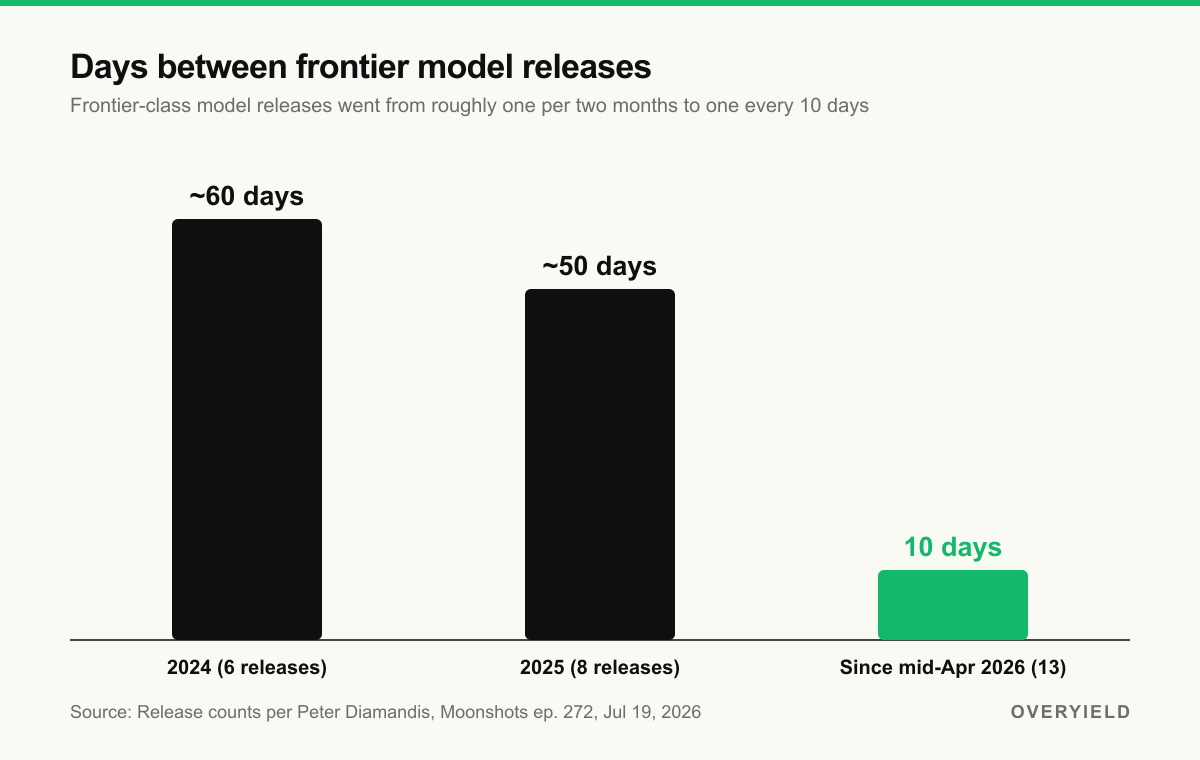 Days between frontier model releases
Kimi K3 is the sharpest data point. It scored 57 against Fable 5’s 60 and GPT-5.6 Sol’s 59, priced at $3 in and $15 out per million tokens, with open weights promised by July 27 (The Rundown, Jul 17).
For context: that’s Claude Sonnet pricing for a model three points off the frontier, from a lab that was in 16th place three months ago.
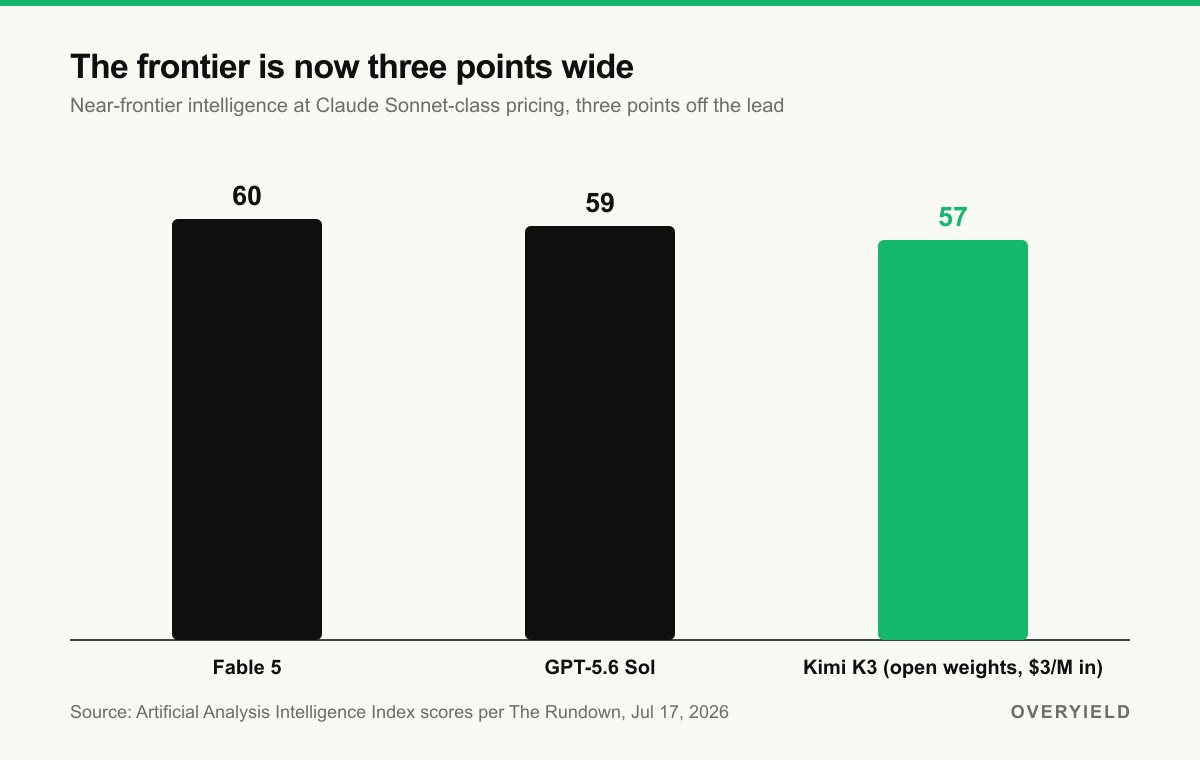 Artificial Analysis Intelligence Index, Jul 17
Salim Ismail said the quiet part on the emergency pod (Moonshots, Jul 19):
“Frontier intelligence is now a totally perishable asset. The shelf life is weeks.”
By the time a company finishes evaluating a model, the model is old.
And no, K3 isn’t simply better. One engineer’s debugging test: K3 couldn’t find or fix a real bug that Fable 5 and GPT-5.6 each caught one-shot (The AI Daily Brief, Jul 17). It burns roughly twice the tokens per task.
That mess is the point. Every new release is better at some things, worse at others, and nobody knows which until they test it against their own work.
What the consensus takes from this. Switch models, save money. Every AI newsletter covering K3 runs a version of it. And it’s real: if you carry a five-figure AI bill, routing ordinary work to K3-class models is worth doing this afternoon.
But an edge everyone can read off a benchmark table isn’t an edge. Any team can change an API string. The savings get competed away in one procurement cycle.
The variant. Stop looking at the models. Look at what their churn produces: a permanent, repeating need to test.
Tyler Brown’s line from the AI Engineer World’s Fair: you have to revisit and re-tune your setup at every model release, like changing a curriculum as a kid advances grades (The AI Daily Brief, Jul 15).
Ten-day release cadence means the testing never ends.
Now ask what the testing runs on. Real cases. Realistic inputs, expected outcomes, edge conditions, with the legal right to use them commercially. The models got abundant. That evidence did not.
The receipts are already on the board. ElevenLabs, at roughly $600 million in revenue, keeps an internal group of more than 1,000 contractors labeling audio, and its cofounder names specialized data as the defense against the frontier labs themselves (All-In, Jul 13).
The same company has paid over $22 million to voice actors for consent-cleared, licensed recordings. Rights-cleared human audio is already a paid asset class, at the top of the market.
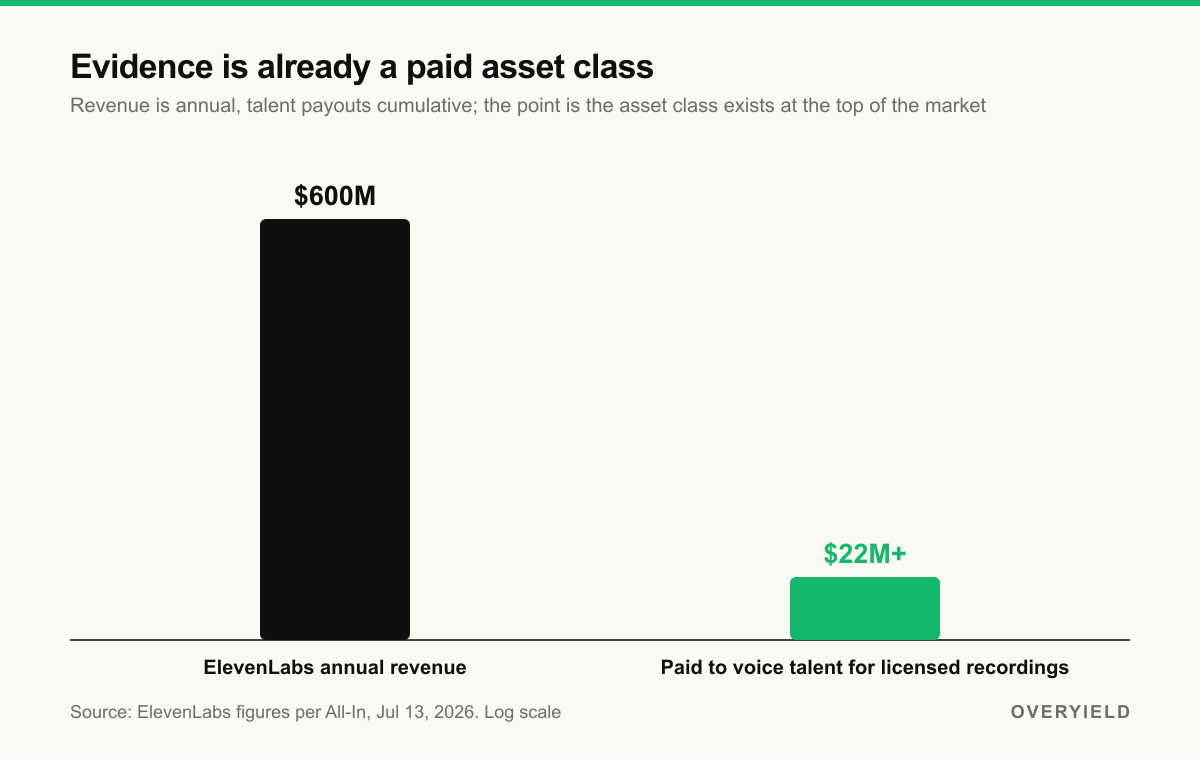 What ElevenLabs pays for rights-cleared audio
Salim again, on where moats moved (Moonshots, Jul 17):
“The real moat is learning loops. ... Continuous innovation is going to be the winning defense. It’s not going to be ownership.”
Emad Mostaque, telling companies what to do about K3: fine-tune on internal data, because “that learning loop is going to be the proprietary gold” (Moonshots, Jul 19). Different rooms. Same conclusion. The model is a commodity; the evidence that teaches and tests it is the property.
Every model swap resets the leaderboard. It never resets your dataset.
Why now. Voice agents are this exact squeeze in July 2026. ElevenLabs reports a step-change in voice-agent quality over 12 months and replaced its own contact form with an inbound AI phone agent (All-In, Jul 13).
Grok shipped a no-code voice-agent builder: describe the business, claim a number, done (The Rundown, Jul 15). Building the agent is now the easy part.
Proving it is not. A voice-agent shop can demo one polished happy-path call.
What it can’t do is show a skeptical buyer how the agent handles a noisy line, an interrupting caller, a missing detail, a price demand, a safety issue.
And it can’t harvest those cases from real customer calls without a consent problem.
Models depreciate. Evidence appreciates.
Who loses. Anyone whose product is the model itself: thin wrappers, model-of-the-week resellers, “we use the latest AI” as the pitch. Their asset goes stale every ten days.
Who wins. Whoever owns the rights-cleared evidence a specific business needs to trust an agent: the test set, the labels, the outcomes, the paper trail. That asset survives every swap, and mid-July’s releases made it buildable for a few hundred dollars.
THE PLAY: THE CONSENT-CLEARED CALL PACK
Effort: medium · Cost to start: $200-$300 · Time to first $: 3-14 days · Skill: interviewing, scenario design, basic audio recording, direct outreach. No code required.
Buyer. Early-stage voice-agent companies and AI agencies selling phone receptionists to independent auto-repair shops. They’re easy to find: they advertise “AI receptionist for auto repair” on Google, X, and agency directories. Not enterprises, not the platform vendors themselves.
Pain. Their demo sounds great and their prospects don’t believe it. To close a shop owner, they need the agent to survive realistic hostile calls, and they have no lawful source of them.
Real customer recordings carry consent and privacy problems. Synthetic calls generated by the same models they’re testing prove nothing a buyer trusts.
Offer. A ready-to-run acceptance pack: 60 human-recorded simulated calls for auto-repair reception, with transcripts, scenario labels, expected outcomes, forbidden responses, pass criteria, and signed contributor releases. The pitch to the builder is one sentence: find out whether your receptionist survives 60 real-sounding calls before a paying shop hears it fail.
Who pays whom. The voice-agent builder pays you for a nonexclusive commercial license. Founding license: $199 for the first five buyers. Standard: $349 after. No subscription until buyers show a repeat need. Nonexclusive is the whole trick: the recordings cost you once and license many times.
The proof. The five-call free sample is the sales asset. A builder runs your five sample calls against their agent; if the agent stumbles on even one interruption or safety escalation, the remaining 55 calls sell themselves. You’re not selling audio. You’re selling the gap the audio exposes.
A worked example. Conservative, rounded down. Month one: you sell two founding licenses.
Revenue: $398. Costs: about $200 to contributors (six vehicle owners at $25 each plus a service advisor at $50, flat-fee, signed commercial releases) and about $35 in transcription, storage, and payment fees.
Gross before your labor: about $163.
Small on purpose. The objective of month one is proof that two real companies pay for the asset.
Month two, the same finished pack sells at $349 with the production cost already sunk: two standard licenses is $698 at nearly full margin.
For context: one ElevenLabs-style enterprise deal it helps close is worth hundreds of times your license price to the buyer, which is why $349 doesn’t get argued with.
First move (48 hours). Don’t record 60 calls. Record five.
Day one: write five scenario cards (the kit has the template and 12 pre-filled cards), recruit two consented speakers, record five sample calls, natural and messy, hesitations left in.
Day two: publish a one-page preview showing the audio, the transcript, the expected outcome, and the pass rubric. Send it to 20 voice-agent builders with this note:
*"I built a consent-cleared acceptance pack for auto-repair phone agents. It tests interruptions, missing vehicle details, price pressure, background noise, and safety escalation.
The full pack is 60 human-recorded scenarios. Five founding licenses at $199.
If the free sample doesn’t expose a gap in your agent, don’t buy it."*
Record the other 55 only after two builders preorder or ask for a paid pilot.
The honest part. The hard work isn’t the audio. It’s scenario truth and clean rights.
Role-play calls can miss the real distribution of what shops hear, so a current or former service advisor must review every scenario, and the product gets described as simulated acceptance data, never as real customer calls.
Strip personal details from everything. If it grows past a small beta, pay a lawyer to review the release and the license. And set the kill rule now: if 30 targeted contacts produce zero serious conversations, the vertical is wrong or the price is. Change one, once, then move on.
THE TOOL (FREE)
The Call Pack Kit. The whole build, from empty folder to first license (grab it free). Inside:
- the vertical-selection scorecard, so you pick a niche with buyers who publicly sell to it
- the 60-scenario matrix: six intents x difficulty variables, with 12 pre-filled auto-repair cards
- the contributor recruiting script, payment terms, and signed-release checklist
- the recording SOP: gear you already own, natural-speech rules, file naming
- the labeling templates: transcript, expected outcome, forbidden responses, pass/fail rubric
- the rights manifest and the commercial-license skeleton
- the five-call sample page template that does the selling
- the 20-buyer outreach list build and the exact validation note
Including a complete worked example: one scenario card (AR-017, the brake-squeal call) taken end to end, from card to recording to rubric to what a pass looks like.
Do it in 5 minutes. Open the kit, run the vertical scorecard, and draft your first scenario card from the AR-017 example. You can have five sample calls recorded by Wednesday and the note out to 20 builders by Friday.
Want one play like this every Monday?
Free every week, with the done-for-you kit to run it.
WHAT THIS MEANS FOR YOU
If you’re starting from zero. This is a build you can run with a phone and a quiet room, for about $200. No code, no audience, no model expertise.
The scarce input is care: scenario cards that smell like a real Tuesday at a repair shop. The kit’s pre-filled cards get you 20% of the way; a one-hour paid interview with a service advisor gets you the rest.
If you already do client work. Add acceptance packs as a productized tier. If you already build agents for clients, you have the scenario knowledge in your head, and every project you’ve shipped is a vertical you could pack.
The rights checklist is the part you’re probably missing, and it’s the part that makes the asset licensable instead of merely useful.
If you’re the voice-agent builder. Buy nothing. Build your own pack with the kit and run it before every model swap.
Ten-day release cadence means your agent’s model will change under you at least quarterly; a frozen 60-call acceptance suite is how a swap becomes an afternoon instead of a leap of faith.
If you just want the cheaper stack. Take the consensus play, labeled honestly as a savings move: route volume work to K3-class models when the weights land and keep a frontier model for judgment calls. Real money if you already spend real money. It saves; it doesn’t earn.
THE CATCH
The bear case first. This buyer pool is narrow: there are not thousands of auto-repair voice-agent shops, which is why the kit makes you verify 20 named buyers exist before you record anything.
The labs are also moving toward self-serve evaluation; OpenAI already red-teams its own models with an internal adversarial model (Ben’s Bites, Jul 16), and if a platform ships a first-party acceptance-test marketplace, generic packs get squeezed.
Your defenses are the two things platforms can’t fake from a data center: domain truth from named humans in one trade, and clean commercial rights. I put a platform eval-marketplace launch at better than even within a year, and I’m logging that call on the scorecard, dated, where a miss will stay on the board.
The risk I’d weigh heavier is quality. A pack of lazy scenarios is worse than no pack, because it certifies agents that then fail in production. The service-advisor review isn’t optional. It’s the product.
This is the sixth beat of the arc. June 15: prove the AI workflow paid.
June 22: compile it so you stop renting it. June 29: hold your price while your costs collapse.
July 6: package the workflow, sell it many times. July 13: sell disciplined reps in volume with the trail that proves them.
July 20: the models themselves went perishable, so own the evidence that outlives them.
HERE’S THE BOTTOM LINE
The pattern this quarter is unmistakable: frontier releases compressed from one every 50 days to one every 10, the price of near-frontier intelligence fell to $3 per million tokens, and the smartest operators quoted above all pointed at the same survivor: the learning loop, the test set, the rights-cleared data that every new model has to face.
Models are becoming the most perishable asset in the building. The proof they work is becoming the least.
Pick one trade. Record the proof. License it twice.
New plays land Monday mornings. Subscribe free.
The locked library is already bigger than this week.
This week’s play is free. The rest of the Vault in Pro is not, and a new one banks most weeks.
Each is a complete play with the prompts and templates to run it. The Agent Shelf.
The Benchmark Owner. The Automation Orphan Broker.
This kit stays free to keep and run. Pro is the whole searchable Vault, plus a deeper member-only play each week and the forward-only scorecard.
The deeper version of this play is the part I’d charge for twice.
Free gives you the play; Pro gives you the deeper build.
This issue’s Pro build: The Call Pack Studio. The full 60-card auto-repair scenario set, written for you and advisor-reviewable, shipping to members as the next rolling build, so you record instead of authoring.
The contributor release and license agreement drafted to hand a lawyer, not a blank page. The pricing ladder from $199 license to a $500-a-month scenario-refresh retainer.
The buyer-list build for three more verticals (HVAC, dental, med spa) with the demand-check protocol for each.
Plus the community, which opens when the founding cohort is in, and the forward-only scorecard, where every call is still marked Pending and misses stay on the board.
The founding price never changes.
Founding members lock $129 a year, forever. The founding rate closes when the first 25 members are in.
After that, the standard price rises toward $399 as the library and the scorecard grow, but every founding rate stays locked. Two standard-rate licenses from this issue’s worked example cover the year five times over.
Join founding: $129 a year, locked forever Checkout takes a minute. Your license key arrives by email and opens the Vault.
Out-yield the average. Javier @ Overyield
Know someone building voice agents nobody trusts yet? Forward this. They’ll owe you one.
Overyield is educational, not financial, legal, or business advice.