
The $2.75 AI task now costs 31 cents. Sell 50 deal reps for $600.
Four cheap frontier models launched in one week. Acquisition buyers still screen 100 listings by hand, at night. The screening service is sitting there unsold.
The signal (TL;DR): Four near-frontier models launched in one week, every one leading with price instead of IQ: GPT-5.6 Sol at about a third of Fable 5’s cost (The Rundown, Jul 10), Grok 4.5 at $0.31 per task where Fable 5 ran $2.75 (AI Daily Brief, Jul 9), Muse Spark 1.1 clearing a full coding benchmark for $0.92 against Fable’s $12.51 (AI Daily Brief, Jul 10).
The same week, Codie Sanchez published the number that matters on the buy side: real acquirers evaluate 100 or more deals before buying one (Contrarian Thinking, Jul 9).
This week’s play: sell self-funded acquisition searchers a $600 screening sprint, 50 public listings run through a cheap-worker, frontier-reviewer harness into a rejection ledger and a 3-5 deal shortlist.
The free 50-Deal Rep Kit is below.
One honest line first: three issues landed in the archive over the past week (the publishing machine broke; we fixed the machine). The June 22, June 29, and July 6 issues are on the site. The play below is this week’s, and the weekly cadence is back.
On July 8, Grok 4.5 posted $0.31 per task on a published comparison, an order of magnitude under the frontier price for the same work. A day later, Muse Spark cleared an entire coding benchmark for under a dollar. The full comparison set, sourced and dated, is in the receipts below.
The coverage all ran the same direction: switch your stack to the cheap models and pocket the savings. Fair enough, if you already carry an AI bill. A beginner carries no bill. The savings round to zero.
The money is in a different reading. When repetitive frontier-grade work falls to cents, the winning product stops being one good answer and becomes disciplined volume: a hundred evaluations a human can audit.
And that same week, the acquisition world told us exactly who buys disciplined volume, in exactly what quantity.
Free kit below. Let’s get into it.
THIS WEEK’S BIG THEME: THE REP ECONOMY
A rep is one disciplined evaluation: one listing, one rule set, one written verdict with a source attached. Until this month, a rep cost an analyst-hour. Last week it fell to cents. That repricing is the Rep Economy.
Execution got repriced, again, and harder. The receipts, all inside three days:
- GPT-5.6 Sol landed about one point below Fable 5 on the Artificial Analysis Intelligence Index at roughly a third of the cost, and beat Fable by nearly 3 points on the coding-agent index (The Rundown, Jul 10).
- Grok 4.5: $0.31 per task vs $1.80 on Opus 4.8 and $2.75 on Fable 5 (AI Daily Brief, Jul 9). Elon Musk’s own framing: Fable is better, but most tasks do not need Fable-level capability.
- Muse Spark 1.1: $0.92 to clear a benchmark that cost Fable 5 $12.51 (AI Daily Brief, Jul 10), priced at about a quarter of top rivals.
- Anthropic went the other way and repriced Fable UP, onto premium credits at $10 in, $50 out per million tokens (Innermost Loop, Jul 8-10). The frontier gets dearer while the floor drops.
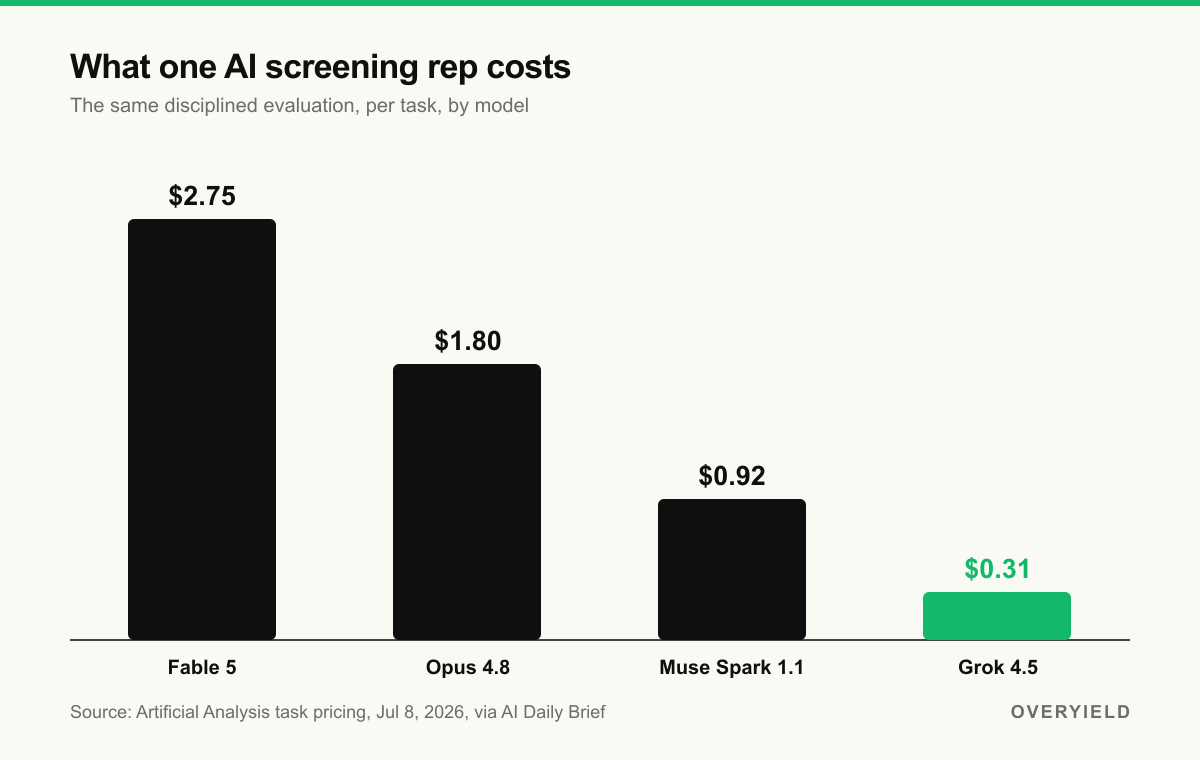 What one AI screening rep costs
The operating pattern shipped in the same window. NLW’s line: 2026 is a harness story more than a model story (AI Daily Brief, Jul 10).
The pattern in practice is a two-tier split: an expensive model plans and reviews while cheap workers grind the token-heavy loop.
Keshav runs one long Fable chat that delegates so heavily to Codex and Droid subagents that he burns Codex quota faster than Claude’s (Ben’s Bites, Jul 7).
Alessio Fanelli runs autonomous work from his phone with a Markdown spec and Linear as the state machine (Lenny’s, Jul 6).
The Rundown published the SOP as a recipe: keep the frontier model for the plan, the risky calls, and the final review; let the worker handle the loop (Jul 10).
What does that make abundant? Answers. Summaries. Research-shaped prose. When any diligent beginner can run bulk extraction for cents, the summary itself is worth roughly what it costs.
What stays scarce is the part the models cannot supply: a buyer’s frozen criteria, evidence tied to original sources, the exact reason each candidate was rejected, the unknowns stated instead of papered over, and a short queue actually worth human attention.
Scarce in the market, and, as of last week, cheap for you to produce. That gap is the whole opportunity.
The demand side wrote its number down last week. Codie Sanchez’s Deal Reps issue (Contrarian Thinking, Jul 9): experienced buyers evaluate 100 or more deals before closing one.
One searcher, Jesus, signed 200+ NDAs before winning a seven-figure acquisition in 2025.
Another, Anna, started looking at a $200,000 car wash and ended up buying a $1.5 million plumbing-and-HVAC operation that grew about 40% a year afterward. Fluency, in her scoring, starts past 20 evaluated deals.
For context: at even 15 careful minutes per listing, 100 reps is 25 hours, a month of a searcher’s nights, and most of those searchers are doing this around a full-time job.
The reps got cheap. The buyers still pay for discipline.
Put those two numbers side by side. The cost of producing a disciplined first-pass rep collapsed last week.
The buyers who need reps in volume have not built systems to get them; they are grinding listings by hand at midnight.
That gap is sellable right now, and almost nobody covering the price war will sell it, because they are busy telling you to switch models.
When answers cost cents, the audit trail is the product.
Who loses. Anyone selling “AI research” as prose: generic deal summaries, unsourced memos, more reading for buyers who are already drowning in reading.
Who wins. The operator who sells the queue instead: verified facts, explicit rejections, honest unknowns, and three to five candidates worth a phone call.
THE PLAY: THE DEAL REP SPRINT
Effort: medium · Cost to start: $0-$50 · Time to first $: 3-7 days · Skill: structured research, spreadsheet logic, source verification, concise memo writing. No code required.
Buyer. A self-funded acquisition searcher with a written buy box, reviewing public business-for-sale listings while holding a full-time job. Start with searchers focused on one industry and one geography.
Not private-equity firms, not brokers selling their own inventory, and not anyone who cannot state their non-negotiables in writing.
Pain. They know judgment comes from volume; Codie’s issue just told them 100+ reps is the price of fluency (Jul 9). But the first pass eats nights and weekends.
Listing formats are inconsistent: revenue, asking price, cash flow, owner hours, and real-estate terms appear in different places or not at all. A generic AI summary hands them more prose.
What they are short of is not reading material. It is a queue they can trust.
Offer. Screen 50 public business-for-sale listings against one written buy box.
Deliver five things: a ledger showing pass, reject, or unknown for every listing; the exact rule behind every rejection; the source URL and captured evidence for every extracted fact; a human-checked shortlist of three to five candidates; and five unanswered questions for each shortlisted broker.
The outcome is 50 consistent deal reps and a short queue worth the buyer’s attention. Explicitly excluded: valuation, legal or financial diligence, broker outreach, and any recommendation to buy.
Who pays whom. The searcher pays you, upfront. Pilot: $200 for 15 listings, delivered in three days.
Standard sprint: $600 for 50 listings, delivered in seven days. No success fee, no percentage of any transaction, no monthly contract until one sprint has been accepted.
The no-success-fee line is not modesty; it is what keeps you plainly in research services and out of broker territory.
The proof. The rejection ledger is the sales asset. A prospect who sees 50 rows, every reject tied to a written rule and every fact tied to a source URL, understands the product in thirty seconds.
Nobody selling “AI deal sourcing” shows their rejects. You will, and that is the trust wedge, the same way this newsletter logs its own calls on a public scorecard.
A worked example. Conservative, one unit, rounded down.
A searcher wants a service business in one state: asking price under $1.5 million, at least $200,000 in disclosed cash flow, no restaurants, no mandatory real-estate purchase. You collect 50 public listings into a source register.
The cheap worker model fills a fixed fact schema; deterministic rules reject 29 listings on explicit criteria; 13 land in unknown because cash flow, geography, or real-estate terms are simply not stated.
Eight enter review, where the frontier model challenges the extraction and you open every original page. Three make the shortlist, each with a source-linked memo and five broker questions.
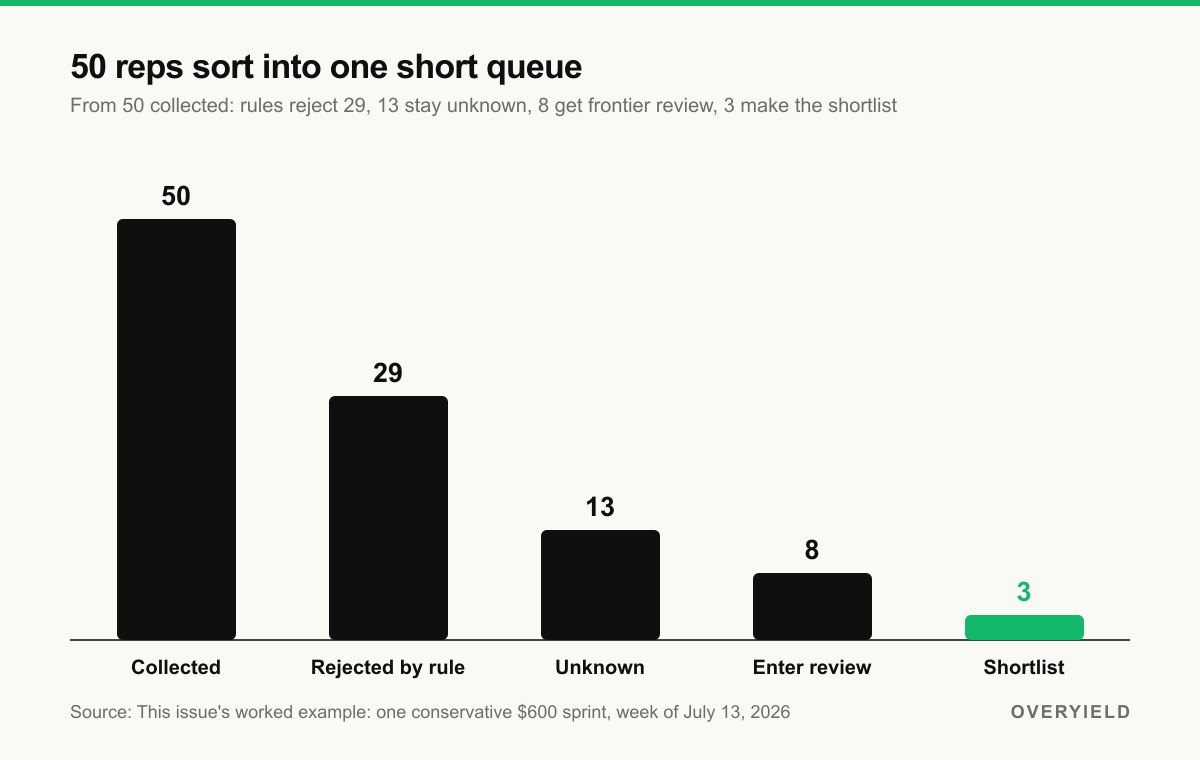 How 50 listings sort down to a 3-candidate shortlist
The invoice: $600, paid upfront. Model and tool spend: about $20, which against the $600 is a 3% cost of goods.
Your labor: about 10 hours across the week, most of it verification and memo writing, which is the part the buyer is actually paying for. Gross before your labor: $580.
Two accepted sprints in a month is $1,200. Not a five-figure claim, and I will not pretend otherwise; it is a real service a beginner can deliver honestly in week one.
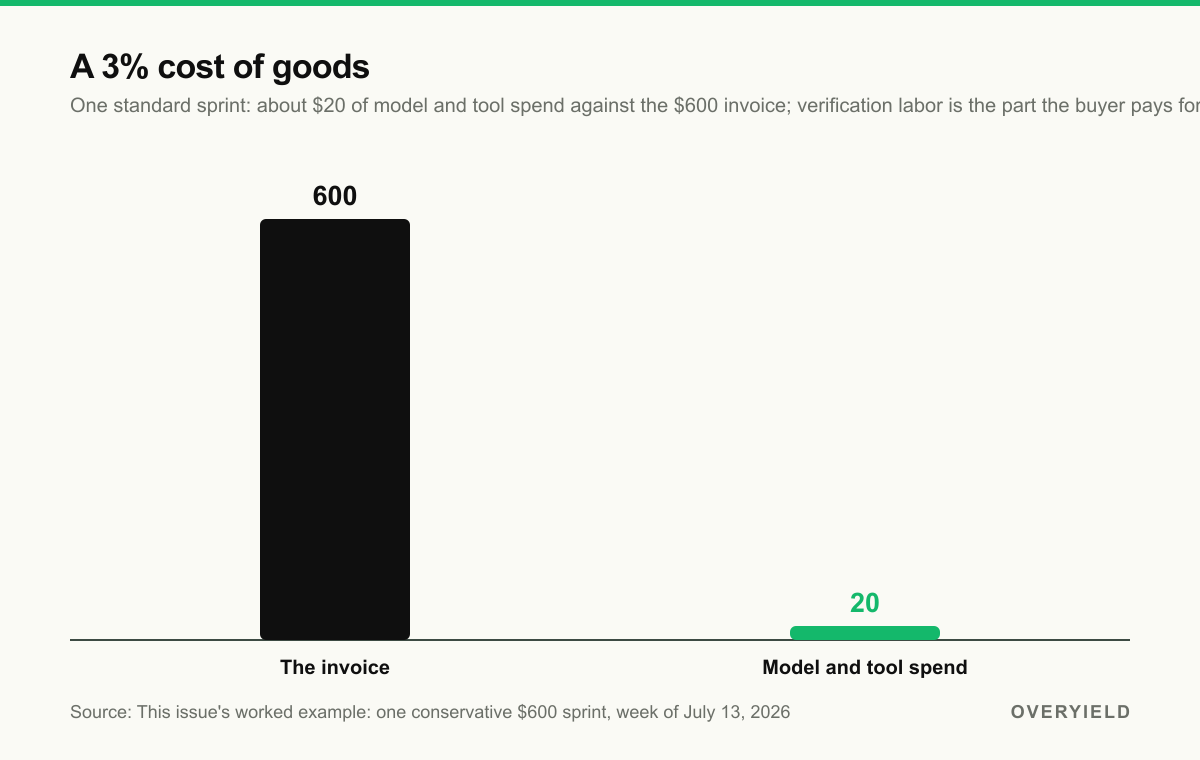 The $600 invoice against about $20 of model spend
First move (48 hours). Day one: pick one listing-dense lane (HVAC, commercial cleaning, vocational schools) in one region, and build a 10-listing demo before asking anyone for money.
Use a fictional buy box, labeled clearly as a demo. Run all 10 through the kit’s pipeline: reject the rule-breakers, preserve the unknowns, and write one human-checked candidate memo.
Put it in a view-only folder with the source register.
Day two: send a plain note to 15 self-funded searchers who publicly state a buy box (they announce themselves on X, on searcher forums, and in SMB-acquisition communities):
*"I turn a written buy box into documented deal reps. I screen public listings, show the exact reason each one passed or failed, verify the short queue against the original pages, and write the broker questions.
Here is a 10-listing sample. I am offering one 15-listing pilot for $200 this week.
It is first-pass screening, not valuation or investment advice."*
Collect payment before adapting the system to their criteria.
The honest part. The math on this play works, but I want the boundary in writing. Public listings are incomplete and seller-supplied.
A clean screen cannot prove earnings, validate add-backs, spot customer concentration, or identify a good acquisition.
It can only enforce the buyer’s stated first-pass rules and expose what remains unknown, and the deliverable must say so on page one.
If the buyer’s buy box is vague, the output will be vague: stop and make them choose criteria before you run anything.
And if an engagement moves behind an NDA, do not accept documents until the buyer has authority to share them and you have agreed on handling. For the first sprint, stay with public listings.
That is where the play is clean.
THE TOOL (FREE)
The 50-Deal Rep Kit. The whole sprint, packed to run (grab it free). Inside:
- the scope-and-boundary page that keeps you out of broker and advisor territory
- the buy-box intake questions that freeze the buyer’s criteria before screening starts
- the source-register and extraction schemas, with the exact worker prompt (facts only, never estimates)
- the deterministic rejection rules with reason codes
- the frontier reviewer prompt that attacks the top 10 instead of praising them
- the human-check protocol and the broker-question bank
- the shortlist memo template and the delivery checklist
- the outreach note with the demo-sample mechanic
Including a complete worked example: one $600 sprint from empty folder to accepted delivery, all 50 rows accounted for, every number shown.
Do it in 5 minutes. Open the kit, pick your lane, and start the 10-listing demo register. You can have the demo screened by tomorrow night and the outreach note out by the weekend.
Want one play like this every Monday?
Free every week, with the done-for-you kit to run it.
WHAT THIS MEANS FOR YOU
If you are starting from zero. This is the rare week-one service: $0-$50 of setup, no code, no audience required, and the demo sample does the selling.
Your only real inputs are care and the discipline to write “unknown” instead of guessing. Build the 10-listing demo this weekend; the kit walks every step.
If you already do client work (research, VA, ops, analysis). Add the sprint as a productized tier under your existing offer. Your delivery muscles transfer directly, and the rejection-ledger format upgrades everything else you sell: any recurring research deliverable gets more credible the moment it shows its rejects and its sources.
If you are the searcher. Run the kit on your own search before paying anyone.
The rep math is the point: Codie’s tracker calls 20+ evaluated deals the start of fluency (Jul 9), and a harness that enforces your own buy box gets you there in weeks of evenings instead of months.
Volume without frozen criteria is just faster noise.
If you just want the cheaper stack for yourself. Take the consensus play, honestly labeled as a savings move, not an income move: install the orchestrator split per The Rundown’s SOP (Jul 10), send extraction and grunt work to a cheap worker, keep the frontier model for the plan and the final review.
Their claimed result is on the order of 60% off the frontier bill. It saves money.
It does not create a customer.
THE CATCH
The bear case first. Searchers are a niche buyer, and finding 15 of them who publicly state a buy box takes real digging, which is why the kit spends a full section on where they congregate.
You are anonymous with no track record, so the demo sample and the rejection ledger carry all the trust. The $600 is not a business until sprints repeat; model two a month, not ten.
And the labor is real: the models do extraction for cents, but the 10 hours of verification and memo writing is the product, and skipping it is how this play dies.
The window has a clock.
The same cost collapse that makes your harness cheap makes a native “AI buy-box screening” feature obvious to every listing marketplace, and ChatGPT Work just shipped the general-purpose version of agents-run-your-research to everyone (Jul 10).
When platforms bundle first-pass screening, the raw extraction is worthless; what stays yours is the frozen-criteria discipline, the source-linked trail, and the client relationships.
We are logging that platform call, dated, on the scorecard, so you can grade us on it. This is not a sure thing.
It is a tracked call, and misses stay on the board.
This is the fifth beat of the arc. June 15: prove the AI workflow paid.
June 22: compile the workflow so you stop renting it. June 29: hold your price while your cost of goods collapses.
July 6: package the workflow and sell it many times. July 13: execution just fell to cents, so stop selling answers and start selling disciplined reps, in volume, with the trail that proves them.
HERE’S THE BOTTOM LINE
The pattern last week is unmistakable: four launches in three days competed on cents per task, not points of IQ, while the buyers who need evaluations in bulk are still grinding them by hand at night.
Cheap execution did not create the deal-rep problem. It made solving it cheap enough to sell for $600.
The margin goes to whoever freezes the criteria, runs the volume, and shows the trail.
Freeze the criteria. Run the volume. Sell the queue.
New plays land Monday mornings. Subscribe free.
The locked library is already bigger than this week.
This week’s play is free. The rest of the Vault in Pro is not.
Each one is a complete play with the prompts, templates, scripts, and kit to run it. The McKinsey Teardown.
The Benchmark Owner. The Automation Orphan Broker.
The Exception Queue Operator. A new one banks in every Monday.
This kit stays free to keep and run. The done-for-you version, the Rep Desk, lives in Pro with the rest of the Vault.
The deeper version of this play is the part I would not put on the public site.
Free gives you the play. Pro gives you the deeper, done-for-you build.
This issue’s Pro upgrade: The Rep Desk. The buy-box intake interview that gets vague buyers to commit to real criteria, the worker-and-reviewer harness configs with the per-sprint cost sheet, the pricing ladder that turns one sprint into a $1,500-a-month deal-flow retainer, the searcher-sourcing playbook for where buy-box buyers actually announce themselves, and the NDA graduation SOP for when an engagement moves past public listings.
It ships to members as a rolling build, intake interview first, and founding members set the order of the rest.
Plus the community, which opens the moment the founding cohort is in, and the forward-only scorecard, where every call we have made is still marked Pending and misses will stay on the board.
The founding price never changes.
Founding members lock $129 a year, forever. The founding rate closes when the first 25 members are in.
After that, the standard price rises toward $399 as the library and the scorecard grow, but every founding rate stays locked. Two accepted sprints from this issue’s worked example, $1,200, pay for the year nine times over.
Join founding: $129 a year, locked forever Checkout takes a minute. Your license key arrives by email and opens the Vault.
Out-yield the average. Javier @ Overyield
Know someone screening business listings at midnight? Forward this. They will owe you one.
Overyield is educational, not financial, legal, or business advice.