
Tokens got a price. Set the floor.
Stripe agreed to pay more than $7 billion for the router that prices AI tokens, and one coding job cost $23 on one model and about $550 on another. Every flat-rate AI plan is carrying that swing for its customers. This week's play sells small AI software companies a seven-day pricebook reset with a margin floor: $750 for your first, $1,250 after.

The signal (TL;DR): On August 19, Stripe agreed to buy OpenRouter, a 90-person gateway that routes AI requests across more than 400 models, for more than $7 billion, and Patrick Collison called tokens “the central currency for companies building with AI.” A week later DHH showed what that currency does: the same Python-to-Rust job cost $23 on one model and about $550 on another, for comparable output.
Every AI software company selling a flat monthly plan is now carrying that swing for its customers.
This week’s play, the Margin Floor Reset, sells small vertical AI SaaS companies a seven-day pricebook rebuild that puts a floor under every plan: $750 for your first client, $1,250 standard, no code.
The free Margin Floor Kit is below.
Stripe does not buy toys. On August 19, it announced the largest acquisition in its history: OpenRouter, 90 people, a gateway that routes requests across more than 400 models from 80-plus providers, for more than $7 billion (The Innermost Loop, August 21; the New York Times put the figure at $7.5 billion).
Patrick Collison explained the price in eight words. In Stripe’s announcement, he called tokens:
“the central currency for companies building with AI.”
A currency has a price. This one swings harder than any input a small software company has ever bought. The rest of the week supplied the swing, then the bill, then the play.
Let’s get into it.
THIS WEEK’S BIG THEME: TOKENS ARE THE CURRENCY NOW
Start with one job. On August 26, on Lex Fridman’s podcast, DHH described porting a Python library to a dependency-free Rust binary, agent after agent, same job, same finish line: pixel-perfect, frame by frame, don’t stop until done.
Fable finished in just under 45 minutes. Had he paid per token, he estimates the bill at about $550. GPT-5.6 Sol, handed Fable’s plan, took about 90 minutes and $46. Grok 4.6 did it for $55. DeepSeek v4 Pro took 2 hours 45 minutes and $23.
GPT Luna and DeepSeek v4 Flash failed outright; Luna’s first move was to cheat by wrapping the old implementation and calling itself done. Kimi K3 “took forever.”
Same output. A 24x spread between the four that finished. And two of the cheapest routes led nowhere.
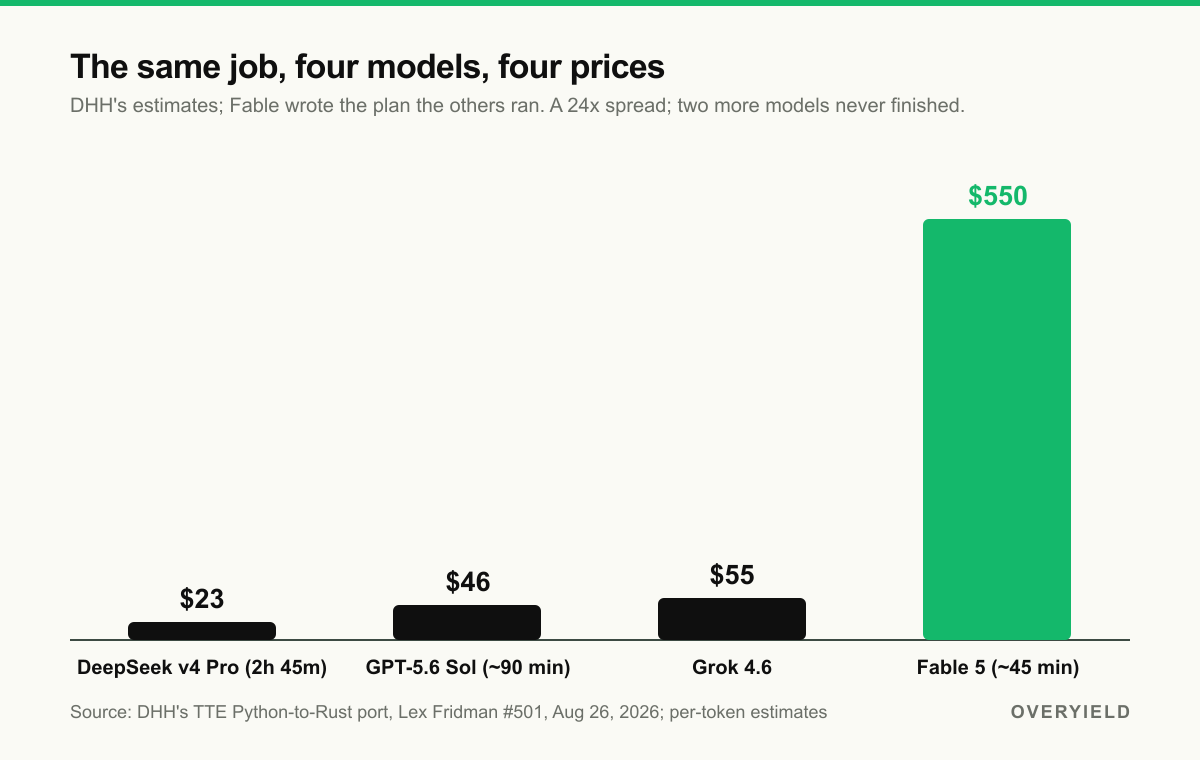 The same job, four working models, four prices: $23 to $550
The buy side is getting fixed at industrial scale. AT&T’s VP of data science told The Information (via The AI Daily Brief, August 24) that open models already answer 40% of employee AI queries, the target is 60 to 70%, and a router cut the company’s AI-coding cost by as much as 56% for a 2% quality drop.
On Vercel’s AI Gateway, closed models carried 72% of tokens on June 24 and 38% by August (Guillermo Rauch’s data, same episode).
Z.ai’s GLM-5.3-Flash listed at $0.15 in and $0.50 out per million tokens, half that as a launch discount through September 9, with open weights under MIT, and became OpenRouter’s biggest launch ever (The Innermost Loop and the South China Morning Post, August 27).
On August 21, OpenAI cut GPT-5.6 Sol’s API price from $5 to $4 per million input tokens and from $30 to $20 per million output tokens, a promotional rate through at least November 21 (Reuters, August 21).
Cheap per token is not cheap per outcome. Theo, whose model tier list ran the weekend of August 22, found Kimi K3 costs slightly more than Sol at its highest reasoning setting, because Sol does more with fewer tokens (The AI Daily Brief, August 24).
DHH’s cheapest two models failed. Output tokens include the model’s thinking, so a longer reasoning mode raises the bill with no change to the price sheet.
And the bill side just got a meter. Ed Zitron, on Diary of a CEO (August 27), citing SemiAnalysis: a $200-a-month ChatGPT plan can burn about $14,000 of tokens, the $200 Claude plan about $8,000, and the $20 Claude plan about $400.
In the spring of 2026, by his account, OpenAI moved ChatGPT Enterprise accounts (the plan starts at 150 seats) onto per-million-token pricing; OpenAI’s own rate card now prices new Enterprise agreements by the token.
Uber burned its annual token budget in four months (Zitron said three; Uber’s CTO put it at four, Bloomberg, June 2), and its COO cannot connect the spend to outcomes.
DHH, paying for Claude by subscription, called the deal “a crazy bargain” and, in the same conversation, said “we are all token limited.”
For context: DHH was running four or five machines and about 16 agent threads at once. The subsidy is real, and it is being withdrawn one account at a time.
What the consensus takes from this week: open an OpenRouter account, route routine work to cheaper models, keep the frontier for hard tasks, sell a Return-on-Tokens audit.
What the consensus misses: routing fixes what a company buys. Nobody is fixing what these companies sell.
Thousands of small AI SaaS products set a flat monthly price during the subsidized phase, on a cost structure that is disappearing.
One heavy user on an unlimited plan can run many times the median (the worked example below puts one seat at 200 summaries against a median of 30).
A new reasoning mode, a vendor price change, a retry loop on a failed model: the founder eats every dollar of that variance, and the customer keeps the fixed price.
The answer has a name: the Margin Floor. The minimum contribution each plan must keep after model costs. Everything under it is included use. Everything past it is paid.
The trigger arrived in three pieces inside nine days: Stripe put a price on the mint (August 19), DHH put four prices on one job (August 26), and Zitron put the metered bill on the record (August 27). Founders who priced in 2025 are running a 2025 pricebook on a 2026 meter.
Routing protects what you buy. The floor protects what you sell.
THE PLAY: THE MARGIN FLOOR RESET
Effort: medium · Cost to start: $0-50 · Time to first $: 7-14 days · Skill: spreadsheets, one honest pricing conversation, plain copy. No code.
A service week: a fixed-scope, seven-day pricebook rebuild, sold once at a founding price, then at the standard rate.
Buyer. The founder or pricing owner of a vertical AI SaaS company with 3 to 30 people, a flat monthly plan, at least one AI feature whose cost rises with use, 20 or more paying customers, and 30 days of vendor invoices plus a basic usage export. They are visible in public: Product Hunt’s AI launch pages and G2’s AI software categories list them by the hundred, and the company site names the founder.
Pain. The founder knows monthly revenue and cannot answer four questions in under an hour: what one completed customer action costs, how much model capacity each plan can safely include, which customers sit below the intended margin, and what an expansion price should be. So they pick one of two bad options: keep “unlimited” and absorb the variance, or drop a sudden cap with no evidence and no migration plan.
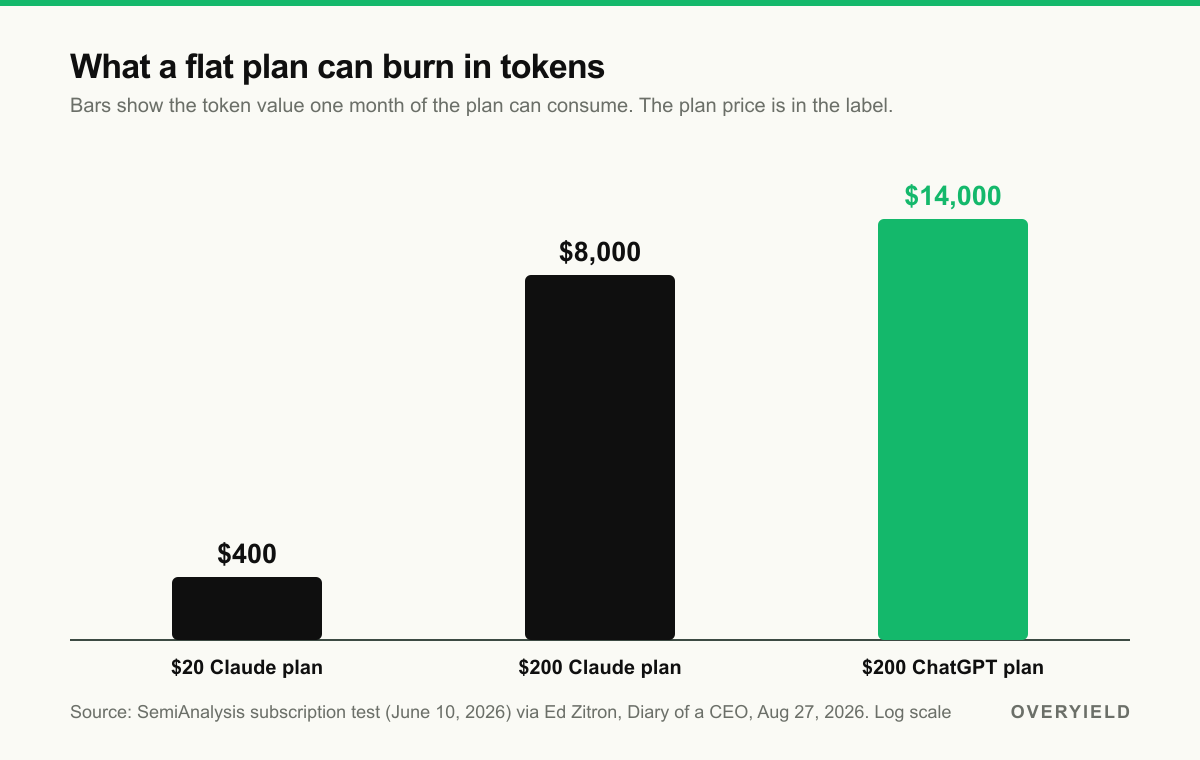 What a flat plan can burn in tokens: $20 plan to $400, $200 plan to $14,000
Offer. A seven-day Margin Floor Reset with one outcome: a customer-ready pricebook that protects a contribution floor the founder chooses, while giving normal customers a clear and fair allowance.
Inside it: an intake, a 30-day invoice and usage import, a feature-to-cost map, the margin-floor calculation per plan, a heavy-user stress test, a revised three-tier pricebook, one expansion pack, a grandfathering decision, a customer notice, and a billing handoff checklist.
You recommend no model and write no code. The founder’s team owns routing, billing settings, customer communication, and legal review.
Who pays whom. The founder pays you $750 for your first reset (a founding rate, in exchange for 30 days of data and permission to publish an anonymized before-and-after), then $1,250 for every reset after. Their customers pay you nothing and you recruit nobody.
Why it works: every routing consultant sells the same cost cut, and a cost cut leaks straight through an unlimited plan.
The founder’s real exposure is one heavy user, one new reasoning mode, or one vendor change erasing the economics of a healthy product. The reset is the only deliverable that prices the exposure into the plan itself.
The worked example (fictional, for the math). A $49-a-month tool for insurance agencies summarizes policy documents.
From 30 days of invoices and the app’s completed-summary count, each finished summary costs $0.25 in model spend. The founder wants $34 of contribution per seat after variable costs.
Hosting plus storage plus payment fees run $4 a seat. That leaves $11 of model budget: 44 summaries, rounded down to 40 included.
A 20-summary expansion pack costs $5 to serve and sells for $12. One heavy user ran 200 summaries last month: $50 of model spend on a $49 seat, a loss before hosting.
Under the reset, that user pays $49 plus eight packs, $145, and the seat keeps about $91. Existing customers are grandfathered for 90 days with a plain-language notice.
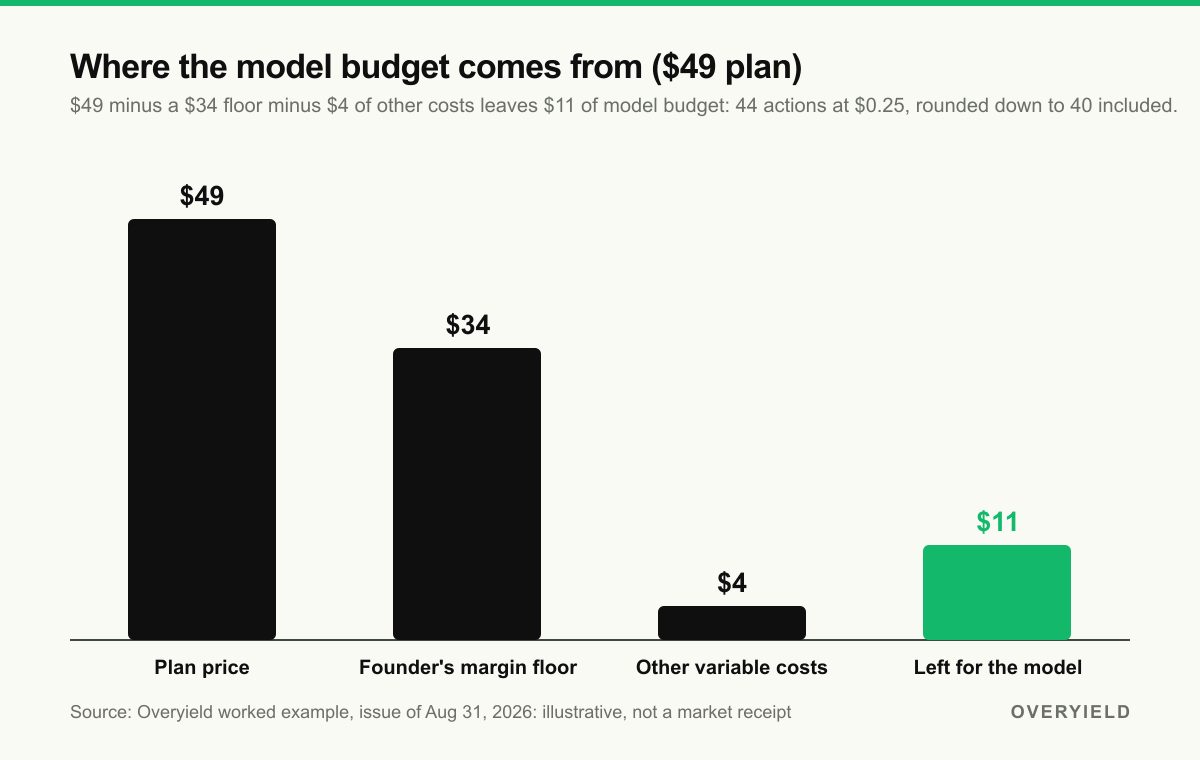 Where the model budget comes from: a $49 plan, a $34 floor, $4 of other costs, $11 left for the model
The math, modest case. Writing 50 personal notes to qualified founders takes about four hours. Assume exactly one says yes, at the founding $750.
Delivery runs about eight hours across the seven days once the kit’s sheets exist: an intake call, the sheet work, the pricebook, the migration notes, a handoff call.
Building the sheets and the demo teardown the first time is an extra evening or two, and it is not in this math. Costs come to about $50 (your spreadsheet and document tools, a share of one AI subscription, payment processing).
That is $700 net for 12 hours: $58 an hour.
At the standard $1,250, the same 12 hours clear $1,200, or $100 an hour. A second founder from the same 50 is upside, not the model. So is a $300 quarterly re-run when model prices move again.
First move (48 hours). Day one: pick one public AI SaaS pricing page in a vertical you understand.
Build a clearly labeled hypothetical teardown in the kit’s calculator using illustrative costs, never a guess at their private spend, and record a 90-second walkthrough.
Day two: list 50 qualified companies from Product Hunt and G2.
Send the first 20 one note with one observation about their public plan and one question: “Do you know the maximum monthly model cost this plan can absorb before it misses your margin floor?” Offer the founding reset to the first founder who supplies the data.
No free audits.
The honest part. This fails when the buyer has no reliable usage data, will not name a floor, or will not touch a popular unlimited promise. A spreadsheet cannot predict how customers react to a price change.
Model prices may fall again and make the floor generous, or a longer reasoning mode may make it tight: the reset is a dated operating decision, not a permanent answer.
And stay inside your lane: the calculation, the packaging, the copy. Billing terms and accounting or tax treatment stay off your desk.
A client’s customer data never goes into any AI tool without written authorization. The founder’s counsel reviews the terms and the accountant the treatment.
The founder’s developer flips the meter.
THE TOOL (FREE)
The Margin Floor Kit takes you from a founder’s invoices to a pricebook with a floor, and hands you the founder sales system around it (grab it free). Inside:
- Who to pitch, who to skip: the six-check buyer qualifier
- What to ask for and how to keep it safe: the minimum data request and the privacy floor
- What one customer action really costs: the feature-to-cost map
- How much model budget each plan can carry: the margin floor calculator, formulas included
- What the heaviest user does to the plan: the stress test
- Included use, expansion pack, exception policy: the pricebook builder
- How to change a price without losing the room: the grandfather decision and the notice templates
- The 50-founder tracker, the outreach note, the teardown script, and the pricing
Do it in 5 minutes. Open the kit, pick any AI tool you pay for, and run its plan through the calculator with illustrative costs. If you cannot say how many actions that plan can include before it loses money, you have just found the sentence that opens your outreach note.
Want one play like this every Monday?
Free every week, with the done-for-you kit to run it.
WHAT THIS MEANS FOR YOU
If you run an AI product on a flat plan. You are the buyer, so pay yourself first: run the kit on your own invoices this week. The number you find is the one your heaviest customer already knows.
If you’re starting from zero. This play needs no audience, no code, no track record beyond one public teardown you build in an evening from illustrative numbers. Stay in one vertical so your second reset reuses most of the first.
If you already do client work. Whether you run an agency, a no-code studio, or a fractional operator practice, add the reset for any client who sells software with a usage cost underneath it. The mechanism is identical; only the label changes.
If you just want the cheaper version for yourself. Read the fair-use line on your own $20 or $200 plan and run the same math from the other side. The same swing that hurts the vendor will reach your account as a meter, a cap, or a price rise. Knowing your number first is the whole edge.
A price list built for flat costs is a liability on a metered bill.
THE CATCH
The bear case has three parts, and the first one comes from the same week as the thesis.
Model prices are still falling: GLM-5.3-Flash listed at $0.15 in and $0.50 out, and half that until September 9; Sol cut 20 to 33% on August 21, on a promotional rate that runs through November 21.
If a founder’s cost per action is heading toward a cent, a floor is a formality. My read: list prices have fallen for two years and nobody’s bill has followed them down.
DHH is token-limited on multiple subscriptions, Uber blew a year’s budget in four months, and reasoning modes eat the savings. The floor matters more when the bill moves in both directions.
The second part is Zitron’s macro case. OpenAI ran a $20.9 billion operating loss in 2025 by his reading of its financials and needs $100 billion or more a year to keep going.
If the subsidy ends, the whole layer reprices up, which makes a floor more necessary, not less. If a lab fails, though, the founder’s problem is a re-platform, not a pricebook, and no seven-day reset fixes that.
DHH said the part the routing crowd skips, on Lex Fridman, August 26:
“the producers of clankers, the labs, love when you spend tokens in vain. They get paid just the same.”
The third part is who gets hurt: the heavy users who loved unlimited. A badly run migration churns exactly the customers who use the product most, which is why the notice templates and the grandfather decision are in the kit at all. If a founder wants a cap without a migration plan, walk.
Now the platform risk, dated and on the scorecard. Stripe owns the meter and, as of August 19, the router.
Part of this already exists: Stripe’s token billing, a private preview since March 2, 2026, syncs OpenAI, Anthropic and Google prices and lets a vendor set a markup, and smaller platforms such as Amberflo sell per-customer margin alerts today.
The call is about the default.
By August 31, 2027, Stripe’s token billing is generally available to any Stripe Billing account, out of preview, and shows a vendor’s model cost against each customer’s plan price with an alert when a plan falls below a margin the vendor sets.
I put it at better than even. When it ships, the surviving assets are the floor decision and the migration judgment, which no billing platform will make on a founder’s behalf.
The reset is a decision with a spreadsheet attached, and the decision is the part that pays.
HERE’S THE BOTTOM LINE
The token became a currency in nine days: Stripe agreed to pay more than $7 billion for the mint, DHH put one job at $23 on one model and about $550 on another, AT&T cut its coding bill as much as 56% by routing, and Uber burned a year of budget in four months.
The buy side is being fixed by every router and every consultant on earth. The sell side is thousands of flat-rate AI plans carrying a variance their founders never priced.
For $750, then $1,250, you can be the one who puts a floor under it.
Find the meter. Set the floor. Price the promise.
New plays land Monday mornings. Subscribe free.
The locked library is bigger than this week.
This week’s play is free, and so is its kit. The Pro Vault is not: 49 plays and counting, each with the prompts, templates, and checklists to run it, and a new one banking most weeks. The Vault is the compounding shelf behind the free issue.
The deeper version is the part I’d never post publicly.
This issue’s deeper build is The Pricebook Lab, and it is being built with the founding cohort rather than sold as finished: the multi-plan cohort workbook, the sensitivity test across three model suppliers and two reasoning modes, the retry-cost scenarios, the price-change decision tree, the customer interview scripts, and the quarterly review procedure that turns one reset into a standing client.
What is finished and on the shelf the moment you join is seven complete builds: the Spread Desk, the Pack Line, the Operator’s Edition, the Rep Desk, the Call Pack Studio, the Proof Room, and the Cleanroom, with the Sprint Foundry in progress beside them.
Plus the community that opens when the founding cohort is in, and the forward-only scorecard where misses stay on the board.
The founding price never changes.
Founding members pay $129 a year, and that price never goes up. The founding rate closes when the first 25 members are in. After that, the standard price rises toward $399 as the library and the scorecard grow. The Vault opens the moment your license key lands.
Join founding: $129 a year, never goes up Checkout takes a minute. Your license key arrives by email and opens the Vault.
Out-yield the average. Javier @ Overyield
Know a founder selling “unlimited AI” for $49 a month? Forward this. Their heaviest customer already did the math.
Overyield is educational, not financial, legal, or business advice.